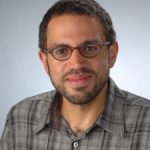
We live in strange times. Political and ideological alignments that once felt stable are scrambling. As Antonio Gramsci put it, “The old is dying and the new cannot be born; in this interregnum a great variety of morbid symptoms appear.” Perhaps the transformation of a leading Black liberation theologian into a Trump supporter speaks to this unsettled and unsettling moment.
For the past forty years, Dwight Hopkins has been closely identified with Black liberation theology. He is considered by many the heir to his mentor, James Cone. As the Laura Spelman Rockefeller Professor at the University of Chicago Divinity School, where he has taught since 1996, Hopkins has trained generations of theologians and scholars of religion. The author or editor of twenty-one books and scores of academic papers, Hopkins is an enormous presence in the academy, serving in editorial and consulting roles and maintaining a busy international speaking schedule. When scholars, students, and church leaders want an entry point to Black liberation theology, they often turn to Hopkins.
Like Cone, Hopkins presents Black liberation theology as rooted in African American communities and their traditions while also attending to global, feminist, and queer calls for justice. He portrays Jesus as a political, social, and religious “revolutionary.” In his account, the task of Black liberation theology, which is “based on the fiber and the soul of the people,” is to “[challenge] systems of white supremacy and the self-imposed shackles of Black folk.”
Hopkins’s writing has always been concerned with questions of economics. He worries that “mainstream Christianity in the U.S. equates itself with American capitalist culture.” He asserts, “Globalization of monopoly finance capitalist culture itself is a religion. Such a religion feeds on the most vulnerable peoples in the world.” Hopkins positions himself as a champion of working people – in implicit contrast to his Harvard classmate Cornel West, about whom he writes, “West is a highly trained, bourgeois black Baptist lay preacher offering homilies to cultured elites about ‘thus sayeth the Lord’ for society’s marginalized” (Religion and Values in Public Life 1:4 [1993]). Yet Hopkins also struggles with the paradox of giving voice to the subaltern, the tension minority intellectuals cannot escape between the role of elite explainer and commitment to the communities in which they were formed.
Hopkins was for many years a member of Trinity United Church of Christ, the Chicago congregation formerly pastored by Jeremiah Wright that once counted the Obama family among its members. During the lead-up to the 2008 presidential election, Trinity was targeted in a right-wing, racist campaign to paint Obama as a dangerous Black radical unqualified for office. When videos circulated taking Wright’s words “God damn America!” out of context, Hopkins stepped into the spotlight as a ubiquitous media presence, often called upon to elucidate the tradition of Black liberation theology in which Wright had been formed. Hopkins explained that he joined Trinity because “they preached and practiced a black theology of liberation … Wright combined a deep reading of the Bible, a highly educated leadership, evangelical worship services, dozens of ministries for poor communities, strong labor advocacy, ordination of women, a welcoming of gays and lesbians, outreach to Africa and the Third World, and a quick wit and humor in one diverse community.”
After enthusiastically supporting the Obama presidential campaigns, Hopkins’s political orientation took what many would see as a sharp turn to the right. Starting in June 2020, he became a regular donor to the Trump presidential campaign, the Republican National Committee, and Never Surrender, Inc., a Trump-aligned political action committee. Around the same time, Hopkins launched D2Venture, a venture capital firm focused on education technology. It is now particularly interested in start-ups that develop artificial intelligence for schools, universities, and families. Meanwhile, Hopkins continues to teach at the University of Chicago. Next term, he is offering a class titled “Black Americans and MAGA,” which aims “to understand and highlight the intellectual contributions of Black MAGA thought.”
How should students of political theology account for this trajectory? Did something happen to shift Hopkins’s views? Under what circumstances does the intellectual project of Black liberation theology articulate with reactionary, fascist, or Christian nationalist political projects? Did the institutionalization of Black liberation theology in wealthy, liberal, predominantly white universities water down its interventions until it no longer threatened – and even began to converge with – the imperatives of neoliberal multiculturalism, even as it continued to use the language of revolution? Does Hopkins’s trajectory, like that of Clarence Thomas, reflect a strand of conservative Black nationalism that responds to the existential insecurity of Black men thrust into elite white spaces by turning nostalgically to the values of an imagined Black community of yore? Was his thought always airy and imprecise in a way that allowed for his political principles to slip away while he was treated with performative deference by white liberal colleagues and with reverence by Black students? Is Hopkins searching for ways to resist the extraordinary burden imposed by his status as Cone’s heir, a role thrust upon him by a swirl of ideological and institutional forces?
This interview with Hopkins was conducted via Zoom on February 25, 2026.
I understand that you grew up in Richmond, Virginia. Could you say a bit about what Richmond was like in the late ‘50s, early ‘60s – segregation had been ruled illegal but was still in practice. Were there things that made Richmond distinct from other parts of the South at that time?
I was born [in 1953] when segregation was still legal. My birth certificate says “Race: Colored” and “Sex: Male.” My father had six sons, two daughters. Back in those days, most everybody had fathers in the house, at least in Richmond. I remember my father taking us fishing. We had to walk past the white parking lot that led to their fishing, and we went to the colored section. I was always curious why we had two different sections for fishing, and the same for swimming. There was no rope or anything. I could just look about twenty feet to the left, and there were white families.
It was segregated, so all the Black classes lived together. Looking back, it was very positive to have role models every day. There were areas we couldn’t go to, we couldn’t drive through, could not live in. Segregated churches. There were places where my mother couldn’t try on clothes.
Richmond was much milder than Mississippi, Georgia, those places in the deep South.
I’m the sixth son, eighth child. My oldest brother is 90 years old. He recalls when they were young kids, the best baseball team member he had was a young white girl. Of course, when they turned 12 or 13, all that ended.
We had more contact with whites under segregation than a lot of Northern [Black] people had. We didn’t grow up worrying about white people. I began to worry about white people once I started integrating, in New England. I think that’s why Malcolm X was so interested in white people, because he was integrated. King was interested in Negro people. Not right or wrong.
I went to New England, and it was like: Oh my God, there’s a whole movement against white people. We didn’t think about white people. My father told all the six sons – they had daughters, too, but it was patriarchal, what can I say? – and me in particular, as the youngest, “We are preparing you. One day that door is going to open. Don’t just walk through. Blow that door off the hinges.”
I was born and raised in a Baptist church. It really was a neighborhood. People watched the children. I went to school, kindergarten, walked by myself twenty minutes to school. Not to discount Emmett Till or all the lynchings, but there’s a texture to Southern segregation that needs to be teased out. My oldest siblings went to school with Arthur Ashe. Randall Robinson was from [Richmond] Virginia. People knew him. All the classes lived together. If there were any differences, it was not so much Black and white, it was the color and class thing. There was a section [of Richmond] in the ‘50s and ‘60s and ‘70s where all Black people lived, but they all looked white. They intermarried. We knew about the privileges they had, but…
Education was a religion in the South, for us. And, of course, church, religion, and family. Country, too.
Then I got a full scholarship to Groton, an all-boys boarding school at that time, thirty miles northwest of Boston. I was there for five years. Excelled.
In one of your books, you mention your grandmother, a Native American. Did she have an impact on your life?
She was a silent type. She was just steady. Nothing in terms of Native American culture. She was more or less absorbed into my father’s father’s family’s culture.
In 1967, you moved North for boarding school. That must have been a very tumultuous time in terms of politics and culture in the country. Was there a sense of turmoil in the air or was boarding school walled off from the turmoil of the nation?
It was walled off. We were in 425 acres of heaven. Everything’s taken care of for you. All the books are free. All your trips are free: Martha’s Vineyard, skiing, French operas, limousines, drivers, butlers, private baseball diamonds. I was like, OMG. All these 1% billionaires. Royalty from Spain were there.
By ’67, something was happening. Black power had started the year before. The liberal wing of people who had money, in that period, [wanted] to expose you, not hold you back. I ordered all the books. There were two hundred students, boys, and there were twelve African Americans. So we could just say, “We need this,” and all the books would come. I had a huge library.
There’s a sense of, they’re isolated, so we need to feed them more about their culture. So I read. I was a voracious reader. Gordon Parks came and spoke to us. One of the Boston Celtics came and spoke to us. The Black stuff was just booming. Grew the Afro and everything.
But ’68 was the turning point: King’s assassination. Everyone was saying, “Malcolm is entertainment, and he speaks the truth, but I’m not joining no Nation of Islam.” When they killed King, my whole generation said, “You told us, ‘don’t follow that guy, follow this guy’.” The assumption was, “Here’s a guy who’s talking about loving white people, turning the other cheek, integration, love is between a man and a woman, fighting for the poor.” My generation, probably age 12 to 30, totally shifted. The mindset… you just could not imagine. The whole sense was – not me, but – burn this motherfucker down.
They asked me to give a Black power sermon. We have a militant in our school.
We went to the Nation of Islam meetings in Boston. You could go to the Panther meetings. I did stuff in the prisons to help with reading. All of this is 14-, 15-, 16-year-olds.
I’m curious about your transition from being part of a Black Baptist community in Richmond to the faith life at boarding school. Did you feel like you were missing something?
When I went to Groton, my Black, Southern, Baptist God pretty much died – the conception we had.
God didn’t die. But the Baptist God pretty much died. That God was: If you don’t wash your hands, you’re going to go to hell. Even when no one’s around, God’s watching you. In the boy’s bathroom at my church, there was an angry Jesus over the sink. So I was like, I better wash my hands.
My belief in a supernatural being still existed but had been modified. These Episcopalians didn’t believe what we believed as I grew up, but they were having a great life.
I sort of drifted away from the church. What helped me were the values passed down from my father and grandfather. If anything, that was the embodiment of God: father and grandfather. And my brothers and sisters and mother, too, but hey, this is my story, I’m sticking to it, you know?
My father had a saying: God will make a way out of no way, but God helps those who help themselves. We were deep in the church, all of us. My mother was in the choir; she ran Bible school. My father was in the choir; he was one of the ushers.
I still would listen to the AM [radio Black church] services on Sunday, the music and the sermon – for the cultural part, not so much the waiting for Jesus. That’s not part of Hopkins theology.
You came to Harvard right when Afro-American Studies was taking form as a field. I’m curious about the intellectual effervescence. Were there teachers on campus who were offering a vision for what Afro-American Studies might be like? Was there a student community that was also thinking about those questions?
A good example is to see how Afro-American Studies was formed at Harvard and how it was formed at Yale. At Yale, the community and professors got together and crafted it. At Harvard students took over the administration building and forced the administration to set it up. They forced them to hire Ewart Guinier. I majored in Afro-American studies. [I was] one of the first majors, and he was my mentor. I was his research assistant.
The administration absolutely hated him. And a lot of the Black faculty and administrators hated him. He was too left. The more they hated him, the more the students rallied around him. But they defunded. He didn’t have the resources and administrative staff. The only tenured Black person in Af-Am was a guy from Germany. We were like, wait a minute, this guy’s from Germany!
All the Harvard faculty and staff except one, David Evans, had white wives and purple Mercedes-Benz’s. Those days were something else.
When [Guinier] left and died, they poured so many resources in. [Henry Louis] Gates comes in, the dream team. They were literally holding up the money and the support until Ewart Guinier retired and died.
You would get stuff from Sékou Touré in Guinea, the latest speech from Kwame Nkrumah, from Mandela. You could get anything you want, especially if you’re a Black student. You demand it! I wasn’t demanding, but it was just part of that culture.
It is something, how they groom people. Groton’s motto is Cui Servire est Regnare, “If you serve, you will rule the world.” They used to be registered to go to Groton at birth. In the first week of orientation at Harvard, I remember the guy saying, “When you graduate from Harvard, you will rule the world.” Can you imagine 17, 18, 19-year-olds being told that?
The Harvard Afro-American Studies Department at the moment you’re describing sounds very political. Were there also religious strands in that Black power intellectual moment or was it pretty secular?
Everything was political because the administration made it political by not supporting it. [Religion scholar] Ephraim Isaac was there. He was very political – and he was just a great guy.
The other thing about [Afro-American Studies] was that it was clear they loved us, and they were supporting us. They wanted us to succeed. They were in the struggle.
And then you took a year volunteering that became five years. What sorts of things were you doing during that interim period between your undergraduate and theological education?
I was going to go to an ivy league business school and become a billionaire. I was going to give all my money away to what we called the Third World. How can you use the privileges of the ruling class to serve poor and working people? I was on the poor and working thing since I was 8, 9, 10 – Black liberation theology was new, but it wasn’t. Not so much from a Communist perspective, but more from a Christian and humanistic perspective.
I said: before I go to B-school and before I make all this money, I will volunteer in the Black community in an urban area. So I went to Harlem. A friend of mine, we drove down from Cambridge – he had gone to Harvard as well. We just moved into an empty tenement building. Couldn’t do it now, but we did. Started just volunteering, just service. People who need to have checks signed or somebody to go downtown to represent them. Absentee landlords. No heat. A lot of old Black people. There was a police brutality case.
My father was big on service to those who were locked out. A mother left a kid on the street; he told my sisters to bring him to the house, give the guy a bath, new clothes, food, find his mother. Not Martin Luther King, he was not into that. So I was coming out of that Christian, Southern, Baptist, and family tradition.
In Atlanta that summer [of 1981] there were missing Black boys. They sent out a call to organizers around the country to raise awareness. One way you raised awareness back in the day was to get notable scholars, cultural leaders, movie stars to sign a petition. I said, well, I know academics.
Must have been around August, my friend who had driven down [from Harvard with me] gave me a two-and-a-half-page article. I still have it. There was a guy on it with an Afro. The article was called, “Left Strategies Must Deal with Racism” [published in Witness, 64:1, January 1981]. I said: church, justice, Black people, education… I looked at James H. Cone. Who the heck is that?
It’s summertime, so I [think] the guy is not going to be there. I called him. He picked up the phone. I was like, “Oh my gosh, Hello Dr. Cone…” He says, “Can you come over in two days?” I said yes.
I was organizing at the bottom of the hill at Teachers College. I had passed Union Seminary for many years. I thought it meant cemetery, literally. Didn’t know it existed.
We talked on the sixth floor of Brown Tower. We talked three, maybe four hours. He was like, “I got time.” I was a smoker, and I was like, “Do you mind if I smoke?” He said, “Yeah, I used to smoke. I just stopped.”
I came in to tell him what’s going on. You know, here’s an elder. He’s just very charismatic, very relaxed, engaging guy.
After four hours, he said to me, “You go down to the second floor, and you tell the director of the M.Div. program that in three weeks you are entering the M.Div. program at Union.” So I dutifully went downstairs. I entered the program. It wasn’t Saul to Paul, but that experience changed my life.
An educated religious person, a person believing in Jesus, social justice, helping poor and working-class people, and for families. I was like, “Wow, my goodness!”
He said, “You’re not going to get any scholarship this year.” I said, “Professor Cone, I’m not coming to Union Seminary to get a scholarship. I’m going to seminary to study Black liberation theology with you.” I got a little loan, but after that I got a full scholarship.
I don’t believe in hocus pocus, and maybe Jesus walked on water or not, I don’t know, but that’s what happened to me.
This is one of the big debates Cone would have: I’m for all people, for whites [too], for all poor and working-class people, particularly African Americans. He [was, too,] theoretically. But he said, “White people, them crackers…” (I got a lot of secrets. I guess I can share them now.)
I have been consistent from day one on that [being for all poor and working-class people]: I might be the only first-generation or second-generation Black liberation theologian who holds that position.
During these five years you were in Harlem, were you going to church? Were you working a job? What was your day-to-day life like?
We would have thrown rocks at churches.
You read Autobiography of Malcolm X? That was the Harlem. Prostitution. Chicken and waffles. All night jazz, blues, jamming, protests, dancing. So I was like, “Wow, this life is incredible!” But I still would listen to [Black church services on] the radio on Sundays.
As a community organizer – community development – you get up and go help people. The community would meet to figure out what people needed.
I’ve always been rooted in a group of people or a community. In all my writing, in all my lecturing, I’m always referring to some specific group. I’m not referring to all Black people. The Church Hill section of Richmond and the Hopkins family, and then my experience of being a student organizer at Groton and Harvard, and then the five years rooted in Harlem, and then when I went to Union, I joined Bethany Baptist Church in Brooklyn. I was rooted there for seven years. (I did a PhD in four years. I could have done it in three, [but] because Cone did it in three, he wouldn’t let me do it.) And then when I moved to Oakland, I joined Allen Temple Baptist Church, and I was rooted in East Oakland. When I came here [to Chicago], I joined Trinity United Church of Christ under Jeremiah Wright, and I was there for 25 years. I was rooted in men’s ministry [at Trinity] for twenty years. When I’m referring to Black people, I’m referring to communities I’m rooted in, and I can speak pretty authoritatively about that.
I’m curious about Trinity. I know you were doing a lot of media around the Jeremiah Wright – Obama controversy. Obama was your fellow congregant there for a while. Looking back at that controversy and at Obama, did you share Obama’s hopes? How did you relate to his candidacy, and his articulation of faith and politics coming together?
I knew Michelle very well. We were on committees together. She worked at the University of Chicago hospital. Big administrator. We used to meet over at the townhouse. Not the multi-million-dollar house they have now. The one they had then was pretty nice.
I dropped my daughter off at the University of Chicago Lab School and he would drop his two daughters off, and we would see each other occasionally, not every day.
The possibility of having the first Black president… I think a little differently now, but… back in the day, it was like a mission, almost a religious mission. The church supported Obama. Even during the controversy. We were all caught up in that. University of Chicago, Hyde Park… a lot of old gray-haired white people here who used to be Communists. If Chicago was Obama heaven, Hyde Park was Obama seventh heaven. I don’t know what he says now, but he supported Black theology then. He supported all the theology of Jeremiah Wright then.
He got a big push when he put Michelle out there. She’s a sister. They thought Obama was this white guy from Hyde Park, from Kenya or Hawaii. He’s not culturally Black. Michelle can snap her neck. If he was married to a white woman, a Jewish woman, it would be the kiss of death. Not that it’s wrong. I’m not married to a Black woman.
The first run, I did 321 [US] media and 272 international media [interviews]. It was awesome, man. It got so tight, I had to cancel class. I told the dean, I’m going to reschedule them. Oh, it was beautiful, man. I felt part of history, regardless of where I am politically now. Everybody’s calling: India, former Soviet Union. It’s just so awesome to be part of service to the nation, man. It’s incredible.
Michelle had a fundraiser in Chicago, and I went. When famous people come, I go the opposite way. Leave me alone, that’s my personality. But she saw me leaving the fundraiser at a huge law office downtown, you know, billionaires, millionaires. I gave my little $10 check. She said, “Dwight, we see you, keep going.” That was a nice affirmation.
I saw that you went from being a teacher to being a student again: you received a business degree in 2019 from Northwestern. What was it like going from one side of the classroom to the other?
It was great. I come from a background of business: father, grandfathers. Of course, they could only do so much because of segregation. My father always told us, “Retire early. Start your own thing. Work for yourself. Take care of your wife. Raise your children and grandchildren.” So I grew up in that ethos. I spent the summer on my grandfather’s farm. He had two farms. One was tomatoes, sustenance. The other was tobacco.
One of my majors at Harvard was global political economy. I got passionate to go back to my first love, to business school, because I think poor and working-class people of all colors need to own wealth in order to take care of their families and to make a contribution to society.
When I first got to Groton in 1967, we had these 13- and 14-year-old boys talking about the stock market. I thought they were talking about cattle. These little guys reading the New York Times and Wall Street Journal at fourteen years old.
I was thinking, I really need to sharpen up this [economic knowledge] for my analysis so I can serve people better through my academic work.
The [place where] I’ve found the most possibility of both humanity and wealth is venture capital, [particularly in] education technology. I found people were secretly having Sunday prayers at the business meeting. There is a whole movement for social justice in venture capital.
It was just great to be on the other side of the lecture hall and to do what students do and hang out.
I’m curious about your teaching now, having gone through that business school experience. Do you still see yourself in the lineage of Cone, or how do you position yourself in relationship to Cone in the classroom now? I understand you’re also interested in Black MAGA intellectuals as a topic – I’d be interested to hear about that.
Cone and I were clear: poor and working people. In fact, he was just adamant about it. I still see myself as part of that. He had a deep [sense of] inadequacy. He didn’t really know how to function around wealthy people. Whereas I could roll like a ball and wax eloquent.
I’ve been talking about wealth and resources for poor and working people since I consciously went to Union in 1981. Now, I can talk authoritatively about finance and wealth. If I were younger, I would start a venture capital business and give all the money away. I’ve come full circle.
My greatest gift from God – I still believe there’s God – is networking. I can put together a network anywhere, all over the world. I’ve done it. Some of them I don’t publish about, but I’ve got networks. And now I’m putting together networks in the finance area. It’s easy.
I found that venture capital in education technology is easy. My gosh! It’s just networking.
How would you respond to colleagues or students who see a discontinuity between the Black liberation theology of the ‘70s or ‘80s and Dwight Hopkins today, who is in the orbit of the Trump world?
It goes back to my father. He’s like, hey, take on the thing that’s most difficult. I’m trained at Groton and Harvard and Union, by Cone, to know the people you disagree with better than they know themselves. That’s almost a quote from Cone. He studied all of Western history, but he refused to teach it. If you went to his library, there are no Black people in there. It’s all Greek, German; he knew all of that.
The thing at the University of Chicago is to teach people not what to think but how to think – the Chicago Principles. The president who made them, he said, instead of putting bubbles around our students, we want them to go directly to the people they have ideological [differences with]. So that’s my whole life.
I’m not part of a cult. I’m interested in poor and working-class people. Full stop. Wherever that leads me, I’m going. That’s why I could never be a politician in the United States. Left? Right?
In the real world, people I’ve been rooted to… there are a lot of Black people who support Trump. They’re in our families, and they are all over. We have a Black mayor here [in Chicago], and in 2024 he was holding an open mic for feedback from the people. Two different grassroots groups were MAGA! I don’t know if they knew each other, but they showed up. This is not an egghead like me. This is the grassroots. But of course CNN, they’re not showing it. Probably just Fox is going to show the other side. So people have no idea. They just assume…
I got all the data [on] how many Black people voted [for Trump]. Whether or not those Black people have buyer’s remorse, that’s another question. I’m an academic taking a slice of history and analyzing it.
I don’t believe that those Black people who supported Trump are not humans. That would be against my sensibility. That would be against the Hopkins sensibility. We had ten people at the table. Six boys. We argued… well, we didn’t argue that much because father wouldn’t allow arguments, you got to work together, but you argue, and then you eat! You go play football!
The idea that somebody who radically differs from me … they’re no longer a human, I can’t talk with them, I can’t be seen with them, I can’t use the language I want, I have to use certain language…
There are like fifty Hopkinses in Richmond. I’m 6th generation. My children are 7th generation. My great-nieces are 8th. We got to Virginia in the 1790s.
Cone would say, take on the people you disagree with or you don’t understand, and learn them to such a degree that when you present their position to them, even if they may hate you, they will say, “That’s me.”
There’s some hard left faculty. [The University was] always sort of progressive, but I’m concerned. How do you teach students? They won’t budge.
I don’t know what MAGA world is. I know what an Obama world is, but I don’t know what a MAGA world…
My touchstone is not a political party. My touchstone is those rooted people I’m dealing with. I was for Obama because he galvanized urban America. I knew he was going to become a billionaire. I had no illusions. That’s what happens when you become president.
I think Trump has actually broken the mold, but that’s another question.
You use the presidency for poor and working classes, like Bill Clinton, and you make money. I may have some moral questions about it, but what am I? I’m just an academic.
I loved Obama, the Obama phenomenon, because he was mobilizing the community, all communities, from below. I was in Chicago. This community was rocking. Even my nieces and nephews in Richmond, they were following statistics on the electoral college. I had never seen that! My goodness, they were doing math, man. So I said, okay, I’m going to support him.
I’m not interested in supporting the first Black anything. That doesn’t turn me on. It was exciting and exotic, right? But the main reason I supported him was because the theology was clear. As a community organizer – I’ve always seen myself that way – he was mobilizing the base.
Whether it’s Pelosi – I have a picture with me and Pelosi and my daughters when I met her out in San Francisco – or whether it’s, well, I haven’t had a chance to meet with anybody on the political right, but… the question for me is what impact, what resources can help to mobilize the base?
Ordinary people, they don’t give a fuck. They have got to take care of children! There’s crime! The people on the south side of Chicago were protesting for more money for the police. I’m always listening to these local people who I know.
The MAGA [class] is academically to continue this method of going deep, deep, deep beyond the media and just reading… they’re all Black Ph.D.’s. These are not some Fox contributors who never got a high school degree. Which isn’t wrong, but you know what I mean. These are academics. There’s a book called Red, White, and Black. It’s a collection of essays edited by Robert Woodson, Sr. You’ll see a lot of them in there.
They’re raising some interesting things. You have political scientists and economists, and they can give the data. They’re not just saying the right-wing critique of Democrats. They’re not just saying the Democratic Party wants to bring illegal aliens in here to take… They’re looking at the history, they look at the welfare programs in the Johnson administration. The impact of those welfare rights, all those things. The number of Black male- [and] female-headed households prior to the ‘60s and the civil rights and Black power movement. Now, three out of four households are headed by a Black woman by herself, something like that.
Their claim is that the problem with the left is that they themselves are racist because they are making Black people think they’re victims. There’s one guy who wrote a book on the new religion of white liberal anti-racism. Whether you believe it or not, it is interesting to think about.
The other thing these academics do is policy analysis. This is what I love. I’m into policy, not personalities. That’s why I couldn’t be a politician. They wouldn’t fund me. They go through the policies of both sides, and they offer their own policies. There’s a book by Horace Cooper called How Trump Is Making Black American Great Again. I’m going to end the course with that. He’s got data in there.
Trump had a Black manifesto – he didn’t call it that – at the end of his first term. He was going to do, like 3 billion, 30 billion… for the Black community! I think I have a copy in my files. I might use that in class. No other president did that! He stabilized and normalized funding for HBCU’s. Maybe it’s trying to get a kickback for the Trump whatever… Those Black HBCU presidents… I saw the ceremony, back in the first term. They are like, “Thank you, Mr. President.” I don’t know what they say now.
We want to go beyond cable and hear what the intellectuals say.
As Hopkins tradition, as an American citizen, as a follower of Jesus – that somebody differs with me radically, ideologically… I can’t talk to them… that’s just not me, man.
When I lectured in western Pennsylvania, there were Confederate flags hanging down. My sister said, “You went where?” I wouldn’t do it now, just like I wouldn’t live in urban areas, Black areas. I might get shot.
I’ve been here 30 years, in Chicago. Every weekend for 30 years six to sixty Black people are shot. Say it’s ten. There are 52 weeks in a year. That’s 520. George Floyd? If people used the same energy [they used] around George Floyd… There’s no uprising, no Black Lives Matter. My heart is saddened by that. It pains my heart that there’s no movement for those… one weekend it was 62 [shot]. Call me a MAGA head or a follower of Jesus.
If I could ask one last question: You already alluded to the polarization of our political moment, felt at the national as well as local levels. Are there practices that you have, daily practices, that help you stay grounded, connected? I understand you play the bassoon. Is that one of your practices?
It’s the family. The Hopkins conception of family. For example, my birthday was last Sunday. One of my kids woke me up with “Happy Birthday.” My brothers and sisters sent texts. Nieces and nephews. They took me roller skating. I almost killed myself roller skating.
To organize the next generation: that’s really where my heart is. That’s why teaching became a natural pathway, not that I’m a natural teacher. If I get this [venture capital] thing, I’d like to do that for a younger generation.
Just rigorous debating. We’ve started the first Black Intellectual Annual International Colloquium series. We go to Europe every year in May and debate people over there. This year we are going to France, to Brussels, and to Switzerland. We’ve been to Italy. It’s our third year.
I’ve always been part of small groups. Boy scouts… Black student unions… at Harvard we organized a Black group and an integrated group. When I went to Harlem, I was with a small group. Here in Chicago, I did men’s ministry with a small group of guys for twenty-some years.
I’ve never been by myself. Always with two or three, planning and thinking, reflecting. Usually knew the wives and children. We could fight. I guess it’s just reduplicating the Hopkins thing. Fight, argue, go out and have drinks, go on retreats. Tight-knit. People could critique me. I don’t listen to everybody. You have to have a tough head because people call me a Communist, they’ve called me a capitalist. It’s a beautiful thing, you know?
Just a good sense of humor. It can be a little quirky. The Hopkins humor… you come home for Christmas and funerals… I have to be careful because I can’t make fun of anybody anymore.
I enjoy different cultures. I enjoy African American culture. I know who I am; I know where I come from. I’ve been here since the 1790s. I love Motown and doo-wop, not hip hop. You don’t need to do breakdancing. That’s not my generation.
And the bassoon as well?
Eight years ago I went to buy a bassoon. A used bassoon was $8,000! I was returning to the bassoon. I couldn’t see investing… I’d have to get a loan, probably. I thought I’d get one for $1,500, maybe, but no, it was $8,000. I couldn’t do that!