
A phenomenologist trained by Edmund Husserl (who directed his dissertation) and Martin Heidegger (who influenced his thinking on technology), Günther Anders begins The Obsolescence of the Human by describing a new phenomenon. “Promethean shame” is the shame humans feel when comparing themselves with the achievements of modern technology.
Consider the factory worker keeping pace with the speed of the assembly line in Charlie Chaplin’s 1936 film Modern Times. Inevitably failing to keep pace, Chaplin’s assembly line worker falls into the machine. Before Chaplin, there was Upton Sinclair’s meat processing worker in his 1906 novel The Jungle, falling into the machinery and vats of slaughter. More subtly, more perniciously, the contest plays itself out on the level of the intellect but also the soul, as Anders reflects, “Surrealism has never been more ‘classically’ realized than in the configuration formed by a human standing in front of a ‘computing machine’” (19).
Promethean shame is novel in history because it can be experienced all by oneself; it does not require being seen by another human or by a god. Promethean shame betrays the soul’s desire to be like the machine, a desire not to have been born in the old-fashioned way, not to be irreplaceable as a human, but to be repairable, replaceable, or, as we now say, upgradable.
In his 1980, Die Antiquirtheit des Menschen, Anders observes, “One builds computers that in a second can produce not only one thousand times more data than one thousand workers in one thousand hours could generate, but also more than one thousand men could use in one thousand hours.” For Anders, the real problem has to do with our inability to comprehend the immensity of that productivity or its effects.
Promethean shame fades into what Anders calls the “Promethean gradient” (Prometheische Gefälle, alternatively, “Promethean gap”), that is the unsettling disconnect between what mechanized, standardized, automated, electronic, digital technologies effect and what we are able comprehend or feel. In his 1956 The Obsolescence of the Human, Anders locates the Promethean gradient in the limitations of the human soul. Faced with AI, ChatGPT, even spell check, we go blank, almost automatically deferring to what we take to be more accurate, faster, better than anything we could do, and certainly: easier.
Anders’s concerns exceed the automated deception endemic in the current day, i.e., dicing and slicing the digitized universe of text in journalism, in science, and in academia. This automated deception extends to life itself, to our very mortality, with military, pharmaceutical, and industrial technologies heedlessly dealing death. Anders argues that we do not and we cannot grasp the stakes.
With the “Promethean,” Anders invokes ancient Greek mythology and its afterlives, for example, in Goethe and Shelley. This is Prometheus the Titan, son of Themis, father of Aidos [shame], who fashions humanity from clay and proceeds to steal Olympian fire for us, we ‘Creatures of Prometheus,’ as Beethoven’s 1801 ballet echoed Goethe’s poem. My cover and ending images by the American illustrator and artist Rockwell Kent (1882-1971) depict a Promethean approach to technology not because Kent was influenced by Anders but because Kent shared Anders’s focus on the titanic in technology.
Nietzsche, too, was fascinated by Prometheus: In The Birth of Tragedy, Nietzsche cites the conclusion of Goethe’s 1774 poem Prometheus, where Prometheus defies the Olympian Zeus:
Here I sit, forming man [Menschen]
In my own image,
A race to be like me,
To suffer, to weep,
To delight and rejoice,
and to defy you,
As I do.
Anders’s account of the Promethean gradient anticipates today’s numbed contemplation. We look on the world with the coldness of zombies. Without sentiment, we see the destruction of Gaza, bombed to rubble and dust, children shot deliberately, entire communities liquidated — and now Lebanon.
The Promethean gradient points to a conceptual deficiency. It is impossible to keep up with or to understand our gadgets [Geräte]. When we become programmed by our things, the word for this synchronization is what Anders called “human engineering,” the very human engineering perfected in military training. Today, such human engineering is effected wholesale by social media, which we avidly consume — Anders called us “eaters” inclined, like force-fed geese (his metaphor), to swallow everything.
In short, for Anders, there is a sharp divide between what we do with technology (better: what industry does on our behalf which we then consume) and what we comprehend of modern technology, especially at a large scale (think geo-engineering) and at a very small scale (think nanotechnologies).
At stake in the Promethean disconnect is the conceptual slippage between the damage we do with the press of button (or the damage programmed by an AI prompt) and our capacity to comprehend that damage. According to Anders, outsourcing war and the decisions of war began in the 1950s when General Douglas MacArthur was downgraded from his renowned World War II leadership to executive impotence in Korea. His strategic decisions were remanded to an “electronic brain” intended to calculate all the data — or, as Anders emphasized, all the data that one could feed to a computer. The resulting damage and death went beyond our capacity to program into a computer or to imagine or to represent to ourselves.
Anders argues that where St. Ignatius of Loyola, the wounded ex-soldier who founded the Jesuits, thought it necessary to devise what he called ‘spiritual exercises’ for his times, we need new spiritual exercises to train our souls to begin to comprehend what we now can do.
The Promethean gradient begins with ourselves in our human, all-too-human mortality. Death-bound, we can scarcely imagine our own deaths, which is to say that we do not think of death (what Heidegger labeled our “inauthenticity”). We deflect death with hollow phrases such as everybody dies. “Standardized ubiquity,” in Adorno’s language, blocks the soul’s comprehension of others when it comes to deaths others die and in the case of today’s social media reports, as Jean Baudrillard analyzed the unreality of televised war in the case of the Gulf War, it blocks compassion for the death of others.
Anders repeats in book after book that we do not think of the dead of Hiroshima or Nagasaki or Korea or Vietnam. Today, we do not think of the Palestinian dead.
The Promethean gradient that Anders identifies also explains our tendency to treat mRNA, microplastics, and forever chemicals as fictions or conspiracies. Our conceptual limitations enable wish fulfillment and denial, blocking our ability to feel any sense of responsibility for what we have already done. We simply cannot grasp what is at stake in the future, which so Anders argued, can work backwards, this is in our power: thereby eliminating all of history. We cannot, so Anders observes, “live up to the Prometheus in us” (231).
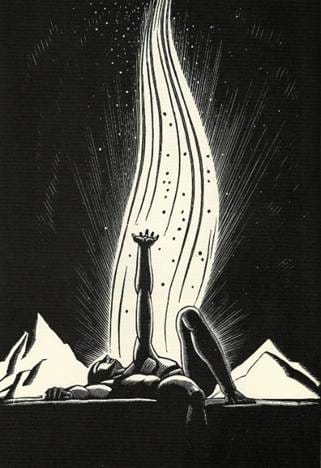
Rockell Kent, Untitled. 1919.





Share This
Share this post with your friends!