
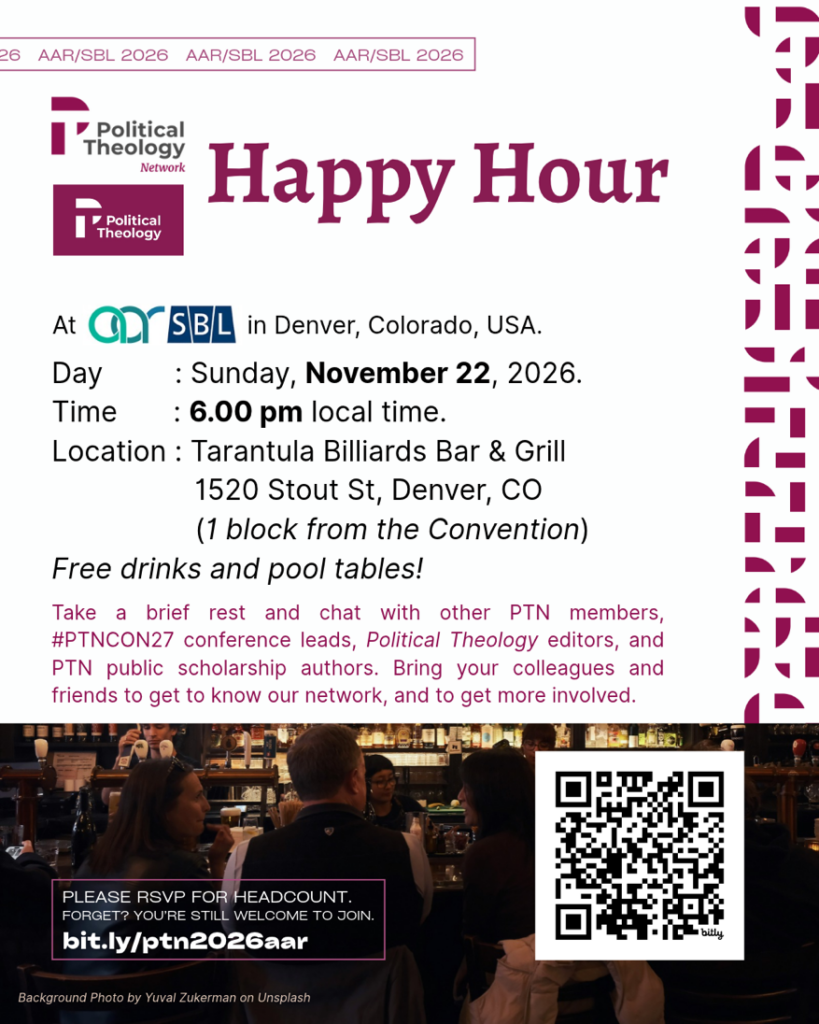
Are you coming to the American Academy of Religion/Society of Biblical Literature Annual Meeting this year in Denver? We plan to host a happy hour. If you want to meet other PTN members, the #PTNCON27 conference leads, Political Theology journal editors, and writers for our blog, this is the place! And bring your friends to get to know us.
It will take place at 6:00pm (local time) on Sunday, November 22, at the Tarantula Billiards Bar & Grille— 1520 Stout St., Denver, CO (only one block from the Convention)— where free drinks and pool tables await!
The Political Theology Unit will be holding four panels this year at The American Academy of Religion and Society of Biblical Literature conference, held in Denver, Colorado, on November 21-24. If you are attending this year and are interested in attending these and other political theology related events, you may find this list to be a helpful guide. You will find that many of the panels this year address topics concerning the political and ethical dimensions of our unit theme: the future. While this list is not exhaustive, we hope it points you in the direction where topics related to political theology are made explicit in the descriptions. We hope you find this year to be beneficial to your research interests, and please be sure to leave a comment if you find a helpful addition to this list.
Political Theology Unit Panels and Collaborations
A21-221
Hosted by: Political Theology Unit
Theme: Reproducing the Future: Political Theology, Life, and the Governance of Futurity
Saturday, 12:30 PM – 2:30 PM
Colorado Convention Center, 105 (Street Level)
How is the future imagined, secured, and reproduced—and what theological assumptions underwrite these efforts? This panel examines how political projects organize life in the name of futurity across contexts including early modern natural philosophy, Nazi racial ideology, transpacific messianism, and AI-driven climate governance.
Central to these accounts is the role of reproduction—biological, social, and conceptual—in sustaining visions of collective destiny. Whether through racialized family, scientific metaphor, or persistent messianic expectation, the future emerges as something to be cultivated and redeemed. At the same time, contemporary governance increasingly translates life into objects of prediction and management, reframing vulnerability as risk.
Taken together, these papers show that projects of futurity depend on theological imaginaries of life, purity, and redemption—even when they appear secular—and invite critical reflection on what forms of life such futures demand.
Brandy Daniels, presiding
Papers
Madeline Levy
(Re)producing “Aryans” for a Redemptive Future: The Strategic Ambivalences of Family in Nazi Germany
Abel Aruan, Villanova University
Bacon’s Wedding: Political Theology of Family and Royal Marriage Tradition in Redargutio philosophiarum, 1608
Der Lor, Emory University
The Messianic Figure is Dead, Long Live Messianism: A Transpacific Political Theology of
Hmong Messianism
Kyong-Jin Lee, Fuller Theological Seminary
Toward an Ethics of Vulnerable Flesh in the Age of AI and the Anthropocene
Business Meeting
An Yountae
Michelle Sanchez
A22-122
Hosted by: Political Theology Unit
Theme: The Performance of Memory and the Pedagogy of Media
Sunday, 9:00 AM – 11:00 AM
Colorado Convention Center, 208 (Street Level)
If political theology refers to shared archives and imaginative slippages between political and religious ways of organizing the world, then memory is a crucial medium where these slippages materially occur. Memory shapes the way sense becomes perception and leads to judgment; collectively, memory supplies a shared background against which appeals to authority and experience can become persuasive. As such, memory is always also performative: rather than a transparent record of the past, memory is a medium for the sense-making in the present in view of a certain kind of future. These papers critically engage the media through which memory is invoked and materialized to teach and form a certain kind of public. They look variously at film, video games, and higher education as varying sites of pedagogy engaged in the curation of collective memory and the cultivation of a kind of human community, often through a correlative strategy of forgetting.
Michelle Sanchez, presiding
Papers
Kristyn Sessions
Forgetting, Remembering, and Higher Education’s Role in Memory Work
Enoch Kuo, Seton Hall University
Negotiating Memories in the Wake of Linguistic Colonialism
Nick Thacker
Pasolini and Marginal Christianity
Seulbin Lee, Vanderbilt University
The Haunted Future: Interrogating Abusive Memorialization of Specters and Moral Agency in the Metaverse of Roblox
A21-415
Hosted by: Ethics Unit and Political Theology Unit
Theme: Aligned with What? AI, Power, and Technology Governance
Saturday, 5:00 PM – 6:30 PM
Colorado Convention Center, 304 (Street Level)
It’s often stated that AI technology should be aligned to human values, but as OpenAI admits, “Aligning AI systems with human values also poses a range of other significant sociotechnical challenges, such as deciding to whom these systems should be aligned.” AI cannot be aligned to human values, but always particular humans’ values, and presumably the values held by a powerful minority. This panel considers the ways developments in AI research and usage interact with existing power dynamics. What theological and ethical resources might help us grasp the operation of power and mode of governance anticipated by the widespread use of AI? How might our fields help us to articulate the human over and against these models, both in response to the question of “alignment” and to the question of the kind of “human” guidance or oversight that LLMs continue to require?
Nicholas Hayes-Mota, presiding
Papers
Benjamin Ball
Providence and algorithmic prescription: new directions for theology and AI
Saman Fazeli, University of Chicago
Aligning the Self: Affect, Ethics, and the Limits of Alignment Discourse in Artificial Intelligence
Berit Reisenauer Guidotti, Boston College
Christian Political Theology, Algorithmic Power, and Algorithmic Possibilities
Madeline Gold
In Whose Image: Technocratic Desires as Eugenic Dysphoria
A22-139
Hosted by: Philosophy of Religion Unit and Political Theology Unit
Theme: Political Theology Reimagined: A Roundtable Discussion
Sunday, 9:00 AM – 11:00 AM
Colorado Convention Center, Mile High 1F (Ballroom Level)
The roundtable brings together a diverse range of scholars to reflect on contemporary political theology in light of a new field-shifting edited volume, Political Theology Reimagined (Duke University Press, 2025). Political Theology Reimagined centers decolonial, Black, queer, feminist, and Marxist modes of critical practice to offer a new, cutting-edge vision of the field that expansively rethinks what political theology means today, and where it is headed tomorrow. Traversing diverse sites, from South Asia to the Middle East to Indigenous North America, and working across diverse scales, from the national to the planetary to the cosmic, this volume help make visible the field’s emerging new identity. Reflecting the rich diversity and interdisciplinarity of the field, contributors to the volumes, like participants of the roundtable, include scholars of literature and philosophy, political theory and anthropology, religious studies and theology. Short remarks by participants followed by a communal discussion with the audience.
Lucia Hulsether, presiding
Panelists
Alex Dubilet
Linn Tonstad
Anthony Paul Smith
Amaryah Shaye Armstrong
An Yountae
Zohar Gitlis, Brown University
Rajbir Judge
Carlota McAllister
Miscellaneous Panels Related to Political Theology
A21-130
Hosted by: Religions in the Latina/o Americas Unit and Religions, Social Conflict, and Peace Unit
Theme: Mobilizing the Dead: Latin American Migrant-led Movements Re-member the Crucified Body
Saturday, 9:00 AM – 11:00 AM
Colorado Convention Center, Mile High 1F (Ballroom Level)
Political theology is emerging from Latin American migrant-led social movements in the United States. Research collaborators interpret organizing practices of Movimiento Cosecha as a form of theological praxis in which migrant communities confront experiences of dismemberment, social death, and political exclusion by retrieving the dead—ancestors, martyrs, and historical figures of resistance—in order to construct a political movement body capable of collective action. Through practices of “re-membering,” fragments produced by migration, detention, deportation, and displacement are brought together into a communal body that becomes both a site of resistance and a theological image of the crucified body of Christ. The practices described illuminate three emerging theological trajectories within contemporary migrant struggles: The development of a grassroots populist political theology, the emergence of a migrant theology centered on a migrant divinity, and the need to decolonize the concept of religion through new practices of solidarity and articulation.
Panelists
Dara Marquez, Movimiento Cosecha
Carlos Castaneda, Movimiento Cosecha
Nicolas Panotto
Janna Hunter-Bowman
A21-335
Hosted by: Theology of Martin Luther King Jr. Unit
Theme: Examining Martin Luther King Jr.’s Theology of Nonviolence
Saturday, 3:00 PM – 4:30 PM
Colorado Convention Center, 111 (Street Level)
Barbara Annette Fears, Howard University, presiding
Papers
Hyungjin An, Department of Philosophy, University of Delhi
Martin Luther King Jr.’s Transnational Christology: E. Stanley Jones, Gandhi, and the Making of Nonviolent Theology
Philip Scholer, Vanderbilt
The American Roots of Non-Violence: King, Niebuhr, and the Crisis of Liberalism
Darren Yau
Black Internationalism’s Political Theology: Martin Luther King Jr. on Boycotts and War Abolition in the World House
A22-238
Hosted by: Theology and Continental Philosophy Unit
Theme: Transmissions: Politics and Theology in Dis/continuity
Sunday, 12:30 PM – 2:30 PM
Colorado Convention Center, Mile High 1D (Ballroom Level)
The papers on this panel explore the theme of transmission from past to present, tradition to tradition, theology to politics. Transmission is constituted by both continuity and discontinuity, by what is reproduced and by what is not passed on. The first paper locates an early image of Christian supersession in the doubled figures of Jesus and Barabbas, tracking a line of descent from this moment of Christian origins through to contemporary political theological questions of sovereignty and civil war. The second paper reveals a line of continuity from the biblical Eve through to contemporary phenomenology via a discussion of futurity and fall. Another paper asks what specifically Christian problems are transmitted to Islam when Muslim thinkers take up political theology and its European sources. The last paper considers the classic philosophical problem of the communicability of divine revelation, specifically its transmission from past to future generations.
Barnabas Aspray, presiding
Papers
Scott Kirkland, Trinity College, Melbourne
Jesus’ Two Bodies: Barabbas and the Christ
Sharon Mar Adams, University of Colorado Boulder
The Birth of the Future: Eve and the Emergence of Human History
Adam Kotsko, North Central College
Political Theology in an Islamic Key: Two Case Studies
Brady DeHoust, Texas A&M University, College Station
“Revelation as a Question of Communicability: Philosophy and the Future of Revelation”
A22-326
Hosted by: Religion and Politics Unit
Theme: Apocalypse, Infrastructure, and Inheritance: Religion and Power in an Age of Crisis
Sunday, 3:00 PM – 4:30 PM
Colorado Convention Center, 404 (Street Level)
This panel explores how religious imaginaries—shaped by apocalypse, mediation, memory, and authority—inform contemporary political life across diverse global contexts. Bringing together digital religion, political theology, and ethnographic analysis, the papers examine how religious frameworks interpret crisis, organize collective action, and shape competing visions of sovereignty, democracy, and the future.
Across cases from U.S. Christian nationalist media to the wartime targeting of Iranian energy infrastructure, Indigenous Christian communities in Northeast India, and European debates over Christian heritage and secularism, the panel highlights how religious discourse operates through both material and mediated forms. The papers show how crisis is not only interpreted but materially produced through war, extraction, and media circulation.
Apocalyptic language emerges as a response to these conditions, while invocations of “Christian heritage” reveal how religious memory continues to structure political identity within secular frameworks. Together, the panel demonstrates how religious imaginaries shape contemporary struggles over power, legitimacy, and collective futures.
Scott Culpepper, Dordt University, presiding
Papers
Morgan Kincade, University of Chicago
Claiming Christian Heritage: How European Christian Leaders Struggle to Disentangle Themselves from Nationalist Logics
Ehsan Sheikholharam, Kennesaw State University
John Miller
Petroleum and the Political Theology of Apocalypse
Andrew Ambrose Mackey, Creighton University
Platformed Prophecy: Digital Prayer and the Politics of Christian Nationalism
A23-132
Hosted by: Religion and Politics Unit
Theme: After Liberalism: The Contested Genealogies and Inheritances of Postliberal Thought in United States Religion and Politics
Monday, 9:00 AM – 11:00 AM
Colorado Convention Center, 507 (Street Level)
This panel examines postliberalism as a contested site of future-making in the United States. While right-wing movements have mobilized postliberal critiques of liberal modernity— particularly regarding neutrality, individualism, and pluralism—for authoritarian projects, postliberal thought also informs competing visions of anti-nationalist and anti-capitalist futures. Through papers on neo-Reformed Christian nationalism, Catholic integralism, domestic reform, and left-leaning postliberal political theology, this panel reframes postliberalism as a contested religious-political imagination through which people interpret theological and historical traditions to envision life after liberalism. The papers offer different genealogies of postliberal thought and examine how postliberal thought circulates across ecclesial, academic, and digital spaces, shaping narratives about community, authority, and moral order. In doing so, the panel highlights how the ways different strands take up postliberal critique reveal struggles over the nation’s future—the future of religion, politics, and democracy.
Lucia Hulsether, presiding
Papers
Joshua Howard, Emory University
From Liberalism’s Ashes: Christian Nationalism and Constructing Postliberal Futures through Digital Media and a Gendered Past
Morgan Barbre
“Suppose Such a Colony”: Finding Postliberalism in American Domestic Reform
Jackson Wolford, University of Notre Dame
Mission Accomplished: Catholic Integralism as Prophetic Violence
Mat Schramm, Emory University
Mourning Postliberalism’s Left Wing
Business Meeting
Candace Lukasik, Harvard Divinity School
Scott Culpepper, Dordt University
A23-128
Hosted by: Philosophy of Religion Unit
Theme: Utopia and Catastrophe: A Roundtable on “Utopia for Our Century: A Manifesto of Hope” (Yale, 2026) by David Albertson and Jason Blakely
Monday, 9:00 AM – 11:00 AM
Colorado Convention Center, 402 (Street Level)
This roundtable responds to the new book by David Albertson and Jason Blakely, Utopia for Our Century: A Manifesto of Hope (Yale University Press, July 2026). Inspired by Utopia, Albertson and Blakely reconsider Thomas More’s insights and methods, and apply them to our contemporary moment. Amid the decline of liberalism, the crises of late capitalism, and the rise of authoritarianism, utopian politics can resist dystopian fears, challenge the limits of realism, and imagine radically new worlds, even in the face of catastrophe and death. Albertson and Blakely sketch a new theory of utopian politics in dialogue with Augustine and More, but also Dorothy Day, Alasdair MacIntyre, and Erik Olin Wright, among others. Panelists will evaluate the book from diverse perspectives, including philosophy of religion, political theology, and ethnography.
David Newheiser, Florida State University, presiding
Panelists
Marika Rose
Susan Reynolds
Devin Singh
Respondents
David Albertson
Business Meeting
Molly Farneth
Joseph Winters
A23-233
Hosted by: Study of Islam Unit
Theme: Islamic ethics and political theology in uncertain times/times to come
Monday, 12:30 PM – 2:30 PM
Hyatt Regency Denver, Mineral C (Third Level)
This panel provides insight into different modes of Islamic ethics and political theology in contexts of social change and instability. The papers explore diverse forms of such responses to uncertainty and precarity: from ritual action and preaching, to legal theory, scriptural hermeneutics, and political mobilization and activism.
Iskander Abbasi, presiding
Papers
Nicole Correri
The Sun Behind the Clouds: Digital Messianic Imagined Futures in Contemporary Western Shi’ism
Fatih Okumus
Sedd al-Zarāʾiʿ and Future-Sensitive Normativity in Mālikī Legal Thought
Simon Wood
Islam as a Religion of Ease: Rashid Rida’s Reading of Qur’an 5:101
A23-238
Hosted by: Religion and Ecology Unit
Theme: Political Ecologies of Justice: Ecological Belonging, Resistance, and More-than-Human Agency
Monday, 12:30 PM – 2:30 PM
Hyatt Regency Denver, Centennial E (Third Level)
This panel examines environmental justice through the intertwined lenses of political theology, ritual practice, mobility, and more-than-human agency, foregrounding how ecological crises are entangled with questions of power, belonging, and imagination. Ranging from biblical interpretation and racialized political ecology in readings of Genesis, to mutual aid food-sharing as counter-rituals of radical hospitality, the papers interrogate how communities contest exclusion and reconfigure ecological belonging in everyday life. They further explore alternative modes of dwelling beyond settlement through nomadic lifeways in the western United States, while also analyzing environmental justice struggles in the Matanza–Riachuelo River Basin in Buenos Aires, where religious and cosmological creativity is proposed as a resource for policy innovation. Finally, the panel turns to unexpected solidarities in postwar El Salvador, where alliances between religious and ecofeminist actors emerge through the agency of land itself. Taken together, these papers challenge anthropocentric and state-centered frameworks by emphasizing ecological justice as a dynamic process shaped by ritual, mobility, material relations, and multispecies entanglement.
Kimberly Carfore, presiding
Papers
Matthew Elia
The Political Ecology of Noah’s Curse
Katrina Myers, University of Chicago
Commensality as Counter-Ritual: Prefigurative Mutual Aid and the Reconstitution of Ecological Belonging
J.D. Mechelke
Nomadic Life on Public Land: Ecological Futures Beyond Settlement
Ben Wagner, University of Chicago
Reimagining Environmental Justice: Religion and Creative Responses to Crisis in the Matanza– Riachuelo River Basin
Juan Martinez Benavides, Drew University
Reimagining Environmental Resistance through Land Agency and Unlikely Alliances in Postwar El Salvador
A23-228
Hosted by: Religion, Colonialism, and Postcolonialism Unit and Theology and Religious Reflection Unit
Theme: Spectral Sovereignties: Haunting, Coloniality, and the Theopolitics of Resistance
Monday, 12:30 PM – 2:30 PM
Hyatt Regency Denver, Agate AB (Third Level)
These papers address futurities that take shape amid colonial spectrality, necropolitics, and racial capitalist dispossession. They engage with efforts to transform futures in ritual work, theological imagination, aesthetic practices, and abolitionist epistemologies.
Marlon Millner, Wesleyan University, presiding
Papers
Nixon Cleophat, Montclair State University
‘Haunting’ the Nation: MAGA Political Theology, Fanonian Decolonization, and a Pan-Africanist Pneumatology of Liberation
C.A.R. Hawkins Lewis, Northwestern University
“Extractivores” as Prophesied Predators: Indigenous Diagnostics of Anticipatory Haunting and Anti-Extractive Methods
Nathan Wood-House, Alvernia University
Border Renditions: Slave Patrols, Secret Police, and Salvation
Anthony Cole, Trinity College Dublin, Ireland
Haunted Conversions: Conquest, Doubled Identity, and Unseen Resources in Theologies of Conversion
Emanuel Padilla
In the Shadow of Luis Muñoz Marín: Puerto Rico’s Messianic Jíbaro
A23-323
Hosted by: Science, Technology, and Religion Unit
Theme: Cara Rock-Singer’s *Gestating Judaism: The Corporeal Technologies of American
Jewish Religion*: A Postpartum Conversation
Monday, 3:00 PM – 4:30 PM
Colorado Convention Center, 503 (Street Level)
Cara Rock-Singer’s Gestating Judaism: The Corporeal Technologies of American Jewish Religion (University of Chicago Press, 2026) employs Jewish technologies such as kinship, rituals, and texts to reveal how individual and collective Jewish bodies are creatively reproduced. The book combines ethnographic fieldwork in the United States and Israel with readings of biblical and rabbinic literature, resulting in a hybrid form Rock-Singer terms ethnodrashy (ethnography plus midrash), to center gendered imaginaries and sexed bodies that have not been normative within the intellectual traditions of either rabbinic Judaism or “the West.” Through immersion in traditionally religious practices like the ritual bath (mikveh) and seemingly secular practices like birth education classes, it becomes clear how reproductive bodies are central to the intellectual, political, and spiritual life of American Judaism. This roundtable will discuss Gestating Judaism’scontributions toscience and technology studies, American religion, gender and sexuality studies, political theology, and Jewish studies.
Laura Levitt, Temple University, presiding
Panelists
Ahmad Greene-Hayes, Harvard University
Sarah Imhoff
Janet R. Jakobsen
Donovan Schaefer, University of Pennsylvania
Respondent
Cara Rock-Singer
A24-112
Hosted by: History of Christianity Unit
Theme: The History of Christianity, National Identity, and the Politics of the Present
Tuesday, 9:00 AM – 11:00 AM
Colorado Convention Center, 105 (Street Level)
The history of Christianity actively shapes political life, and political life actively shapes the history of Christianity. The papers in this session examine with particular urgency the conditions under which that history becomes a contested resource for shaping public life. Across three distinct contexts, the American classroom, the genealogy of Christian nationalism, and the wartime formation of religious institutions in Ukraine, the papers collectively ask how the history of Christianity is mobilized, mythologized, and institutionally remade in response to present crises.
Drawing on pedagogy, intellectual history, and qualitative fieldwork, the session addresses questions of enduring relevance about the authority of historical narratives, the entanglement of religious and national identity, and the ways in which the history of Christianity is produced, instrumentalized, and studied. Together, the papers demonstrate that how the past is narrated is never simply an academic question; it carries direct consequences for political imagination, institutional formation, and the future of public religious life.
The session speaks to ongoing conversations in American religious history, intellectual history, Christian nationalism, political theology, church-state relations, sociology of religion, and the pedagogy of the history of Christianity.
Minji Lee, Montclair State University, presiding
Papers
Matthew Pereira, Oklahoma State University
Teaching Early Christianity in a Politically Polarized America: Pedagogical Challenges and
Opportunities at the 250th Anniversary of the Declaration of Independence
Anna Rosensweig, University of Rochester
The United States of Calvin: How Christian Nationalists Frame the Past to Shape the Future
Valentyna Kuryliak
War as Institution Builder: The Emergence of Interfaith Military Chaplaincy in Ukraine
Business Meeting
Minji Lee, Montclair State University
Roy Fisher
