I would like a vote in the decision to choose the next Archbishop of Canterbury. Ideally, if I am honest, secretly, I would quite like to have the only vote. But that would be monarchy, and I don’t believe in that for all sorts of reasons, and nor do I believe in oligarchy, so what I would like to see is a democratic election. Perhaps something like they have in the Episcopal Church in the US, an open contest in which candidates put forward their ecclesial and spiritual credentials…
During the past two decades, political liberalism has been put on trial. Political theorists indebted to Sheldon Wolin (William Connolly, Romand Coles, Bonnie Honig) have, in various ways, exposed liberalism’s tendency to conceal or downplay significant dimensions of political struggle. These authors indict liberalism for its narrow understanding of public reason, an understanding that underestimates qualities, practices and interactions within our lifeworlds that tend to thwart liberalism’s drive toward consensus and agreement (here I am thinking of clashing visions of the good life, memory of injustice, or the emergence of new movements that challenge our very notion of publicity and reason). This trend within political theory resembles developments in religious studies and theology. Recent discussions between Stanley Hauerwas, Jeff Stout, and Cornel West revolve around liberalism’s tendency to depoliticize religious commitments by relegating them to the private sphere. For these authors, this inclination overlooks the deep connections between democratic struggle and religious practice within American history. These authors remind us that democracy and faith are bedfellows (and not necessarily strange ones).
Jonathan Kahn and Vincent Lloyd, in recent blog posts here, attempt to move these discussions further and potentially in new directions…
With the elections in Spain two weeks ago, the first modern government to explicitly model itself on the work of an academic political philosopher was voted out of office. The Spanish Prime Minister, Jose Luis Rodriguez Zapatero, had become a devotee of the Princeton political philosopher Philip Pettit in 2000, when Zapatero was leader of the opposition searching for how to envision left-liberal politics distinct from the Clinton-Blair “third way.” As a Zapatero associate put it, “Philip Pettit provided us with the appropriate grammar to furnish our political intuitions, to express the kind of proposals and dreams we had in mind for Spain. Pettit’s republicanism has been our north star.” Does the political philosophy that Zapatero found so compelling, civic republicanism, leave a role for faith?
By Jonathon Kahn, Vassar College
Who are the fools among us who continue to have faith in democracy and in American democracy in particular? After a desultory three-year period of community organizing in the corner of Harlem that I call home, I find myself preoccupied with this question. My community was unable to bridge the gap between what came to be called the “old” and “new” Harlem. To be sure, there were moments that Bonnie Honig might call “democratic ruptures,” when my community tried to rework its own sense of “we-ness.” But these moments were fleeting. “Ordinary life,” as Honig says, “reasserts itself, with a bit of a vengeance.”[i] Democratic energies dissipate. Democratic energies fail.
And yet I find myself wanting to argue that democratic faith is possible and needed. Though I have no theistic beliefs of my own, I can find no way to move forward with democratic life except as a person of faith. What, then, do I mean by faith and why does democracy need it?
First, I want to take social practices and norms as foundational. They do not come from anywhere else, not from people or institutions or God. It is practices and norms all the way down, as it were. Second, I want to present practices and norms as always in conflict. Norms are derived from practices, but they always misrepresent practices; practices are pulled towards norms.
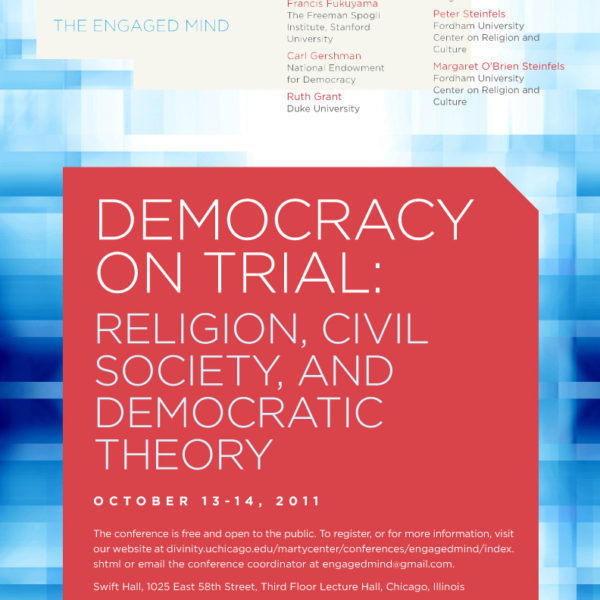
What is the state of our democracy? Is democracy good for the world? How does religion support or hinder democratic practice? Throughout her career, Jean Bethke Elshtain has challenged both liberal and conservative approaches to politics, emphasizing the crucial role that the mediating institutions of civil society play in a successful democracy. She has identified the forces that oppose democracy: identity politics, utopianism, and an elitism that denies ordinary people the prerogatives of citizenship. Yet she has consistently maintained a realism tinged with hope, pointing to Jane Addams as an exemplar of lived democratic practice.
Locating a middle requires, first, the critique of ideology, which determines the options that appear before us. But the critique of ideology requires an attentiveness to tradition, and to social practices and norms. The “Continental” side talks a lot about ideology critique, but rarely does more than gesture towards those social realities.
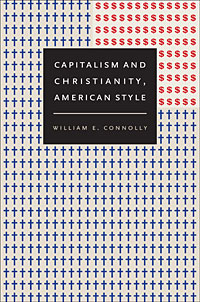
This essay is part of a collection of papers on William E. Connolly’s ‘Capitalism and Christianity, American Style’ published in Political Theology 12.2.
This speaks to a division in our politics, a separation of policy from the profound. President Obama sounded like a technocratic Ronald Reagan – optimistic that we can out-compete emerging nations.