
In November 2023, the Financial Times published a report titled “How China is Tearing Down Islam.” It documented the widespread disappearance of domes and minarets from mosques across the country. The changes were mandated by the nationwide and ongoing campaign called Sinicization (zhongguohua) of Islam. The campaign accuses the Muslim minority groups of practicing the so-called “Arabization” and “Saudization” trends.
As I described elsewhere, Sinicization of mosques is part of a larger assimilationist trend that unfolds in China since 2016. Coming after four decades of economic reform, the trend targets forms of difference and alterity that contradict the monolith image of the Chinese nation as imaged by its current leadership. The first alterations began in 2018. But their number peaked during the pandemic lockdowns. Of the 2,300 mosques identified by the Finacial Times, more than two-thirds reportedly underwent visible alteration. Many had their domes and minarets removed, others had them replaced with traditional Chinese designs like hexagonal pavilions or gazebos with tiled roofs. Some even witnessed complete demolition.
This image of campaign’s uncompromising linearity, however, falters the moment we shift online. Type the name of these mosques into Chinese search engines today and you are confronted with a temporal glitch. There, the sinicized looks looks blend together and appear side-by side with the now altered “Arabic” styles. A Baidu-engine search for Qinghai Province’s landmark Dongguan Great Mosque, for example, shows its iconic golden dome alongside photos of its massive temple-style roof now sitting heavily on the same foundation since 2021 (picture 1). As if uninterested to argue with history the way Sinicization does on the ground, the algorithm treats these two distinct looks as equally valid, and ‘real.’ It is as if there are not one but two buildings that now go by the same name and location. Far from disappearance, therefore, the image of Sinicization online is one of uncanny doubling and multiplication.
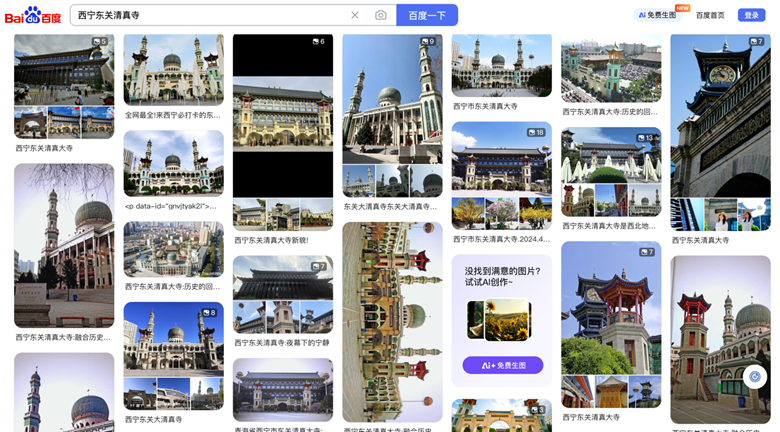
Picture 1. Screenshot results from the “images” section of the Baidu search for the “Xining Dongguan Mosque,” taken on January 26, 2026.
The visual availability of the now banned design is far from being residual to the campaign. Indeed, when the narratives about Sinicization emerged online, they did so through a powerful medium of visual juxtaposition called “before-and-after” images. This medium brought and held together the “Arabic” and the Sinicized style in one single frame. As the campaign progressed, these diptych photo-forms grew into a considerable repository that the nationalist public still uses to track the Party-state’s triumph against “Arabization.” Welcoming the appearance of domes and minarets at the time when the campaign swiftly disappears them on the ground raises critical questions about the politics of assimilation in the digital age. What do these images show and how do they qualify the Sinicization campaign?
Soviet film director and theorist Sergei Eisenstein once argued that the juxtaposition of two contrasting images creates a new, third idea that wasn’t present in either image alone (1957). This was his theory of intellectual montage whereby an abstract concept could be powerfully visualized through the synthesis of opposites. The “before-and-after” images perform similar function: they bring the opposites together in one single frame to give Sinicization its shape and form.
Consider the “before-and-after” diptych of the sinicized Chongqing City Mosque (picture 2). It compares a massive, flat-roof structure with a bird’s-eye view of the same building featuring eight bulbous domes, four towering minarets, and numerous crescent finials. The montage of disappearance thus created vividly illustrates how Sinicization recruits–or, shall we say, resurrects–domes and minarets of the recent past to show their absence in the present. This spectral opposition conceals–or, shall we also say, betrays–the campaign’s structural dependence on the very “foreignness” it seeks to resect. “Wow,” one internet user comments, “mosques all across the country are removing their green domes and switching to Chinese-style designs — they look absolutely gorgeous!” (Xinlixue Tanmizhong, 2025)
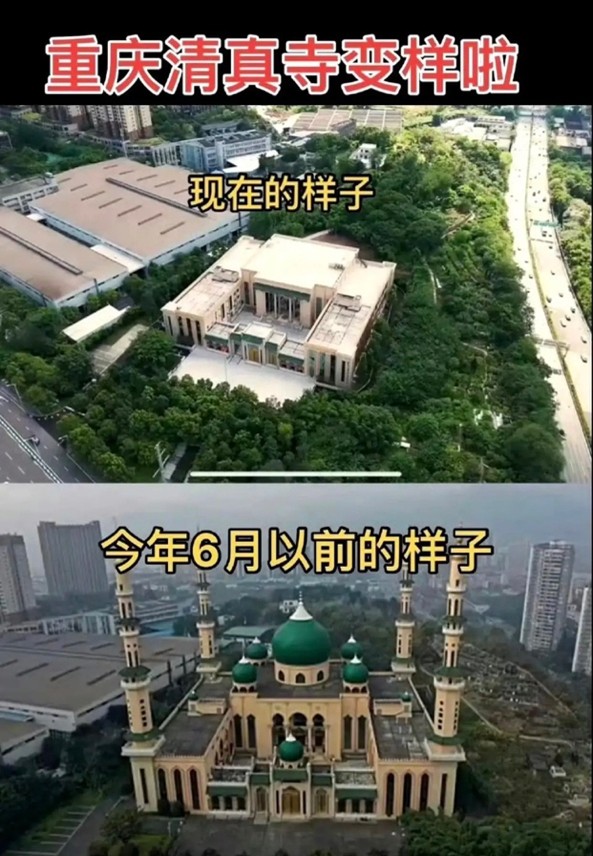
Without the domed photo, however, it becomes impossible to understand what makes the unremarkable, flat-roof structure look either “gorgeous” or “Chinese.” It also becomes difficult to recognize the mosque as a religious building at all. “This kind of transformation wasn’t something that happened overnight, but rather a gradual process,” the user continues. “During my lunch break, I scrolled through a few of these comparison photos on my phone. I have to say, the changes are indeed quite significant… The entire architectural style has undergone a dramatic transformation.” By preserving the visual presence of domes and minarets, the “before-and-after” images conceal the utterly shapeless nature of Sinicization.
But the montage of disappearance is not simply a visual aesthetic of opposition and contrast. As The Finacial Times report shows, the alterations may either end in a flat roof or continue with the imposition of the “Chinese architectural elements,” but both result from amputation which is Sinicization’s primal scene. In other words, the juxtaposition constructs the image of Islam that is defined by the lack of domes and minarets. It thus follows that the “before-and-after” is also a montage of privation that takes deficiency into a precondition of ethnoreligious belonging in Xi-era China.
The Chongqing mosque’s image shows this most clearly when it places the amputated look on top and the domed photo on the bottom of the diptych. The mosque, for context, was built in 2020, so the sequence of this presentation might at first suggest that the photos shows the appearance of domes and minarets towards the building’s eventual completion as a mosque. Yet the caption of the domed photo, which reads “this is how it looked before June this year,” validates amputation, not growth. It prompts the viewer to come back to the top image, thus creating a temporal loop which robs the domed look of its completed status and assigns it instead to the sinicized version.
According to this logic, the mosque was already finished and complete when it stood without the “Arabic-style” features, and so it was never meant to have them in the first place. As a result, the domes and minarets indeed begin to spoil the normative deficiency of the mosque. They indeed begin to look like evidence of an unwarranted “foreign influence” that caused the mosque to “overgrow.” This helps to construct Islam in China as deficient, a normative condition that “Arabization” has allegedly tampered with and which Sinicization now seeks to restore. Arguably, this is a kind of deficiency that the user above celebrates as “Chinese” and “gorgeous.”
But the medium of binary juxtaposition also normalizes another potent image of deficiency as stigma. This is because the campaign frames the initial, domed architecture as inherently lacking in the requisite “Chineseness.” Here, Sinicization functions as a Derridean supplement that fills the void of that original lack, establishing the amputated mosque or the pavilion-style dressings as the authentic, complete, and acceptable forms. Derrida reminds, however, that the supplement functions as a supplement when it retroactively casts the supposed original as already in a state of lack (2016). By staging the amputation and replacement with stark contrast, Sinicization once again reveals its foundational need to rely on the “foreign” to define the new and privileged one.
The presence of domes and minarets as “foreign influence” violently inscribes this original lack onto the building’s body, transforming the minority that the mosques represent into a group that is suspected of never being Chinese enough. “Changing the skin without changing the heart is pointless,” one Weibo user cautions beneath a reposted diptych (Youqin Shuge 2025). “The alteration wasn’t thorough enough,” another user writes, “Next time, we should take it further–remove all the solid walls and replace them with glass or fences, so everything is exposed to the sunlight and filth has nowhere to hide.” One comment removes all the solid walls indeed, though not around the mosque but around ethnic hatred and Islamophobia: “Just tear it down completely to solve the problem at its root cause!” The sinicized mosque stands as a constant, stark reminder that the Muslim minority cannot be sufficiently Chinese even if it is deficient in Islam.
The diptych photo-form lends itself fully to articulating and holding these two forms of deficiency in one single picture. It simultaneously celebrates the “after” image for exemplifying the normative lack that Islam in China has supposedly lost to “Arabization.” It also holds onto the “before” image to establish lack as a persistent stigma of not being fully “Chinese.” This adds to the structural paradox that the campaign executes on the ground. On the one hand, Sinicization claims that “Arabization” has tampered with the direction of Islam in China. On the other hand, however, it tampers with the mosques’ structures, hence with the direction that Islam had taken before it. The mutilation and amputation are presented as a necessary remedy, which invites parallels with pharmakon. This is a Greek word that is also uncanny because it can mean both a poison and a cure simultaneously (Derrida 1981). The diptych thus shows how the policy’s triumph over “Arabization” is measured by the visual evidence of the disease Sinicization claims to cure, for the cure requires the disease to name itself. In this perpetual loop of juxtaposition and contrast, Sinicization creates the very ailment for which it then offers a state-sanctioned treatment. But because the mosque’s architectural integrity is also the image of Islam in China, the proposed remedy poisons the strength of Islamic minority group and mutilates the mosque’s integrity as a basis of inclusion today.
I want to conclude this discussion about deficiency by turning to a two-minute video from the Chinese internet. In it, an account holder named CZshenliming narrates how he stumbled upon a women’s mosque when strolling through the park in Changzhi City in Shaanxi province. “I stepped in to have a closer look,” he says, “and found myself mesmerized by its exotic charm.” At this point, the camera leaves the park and shows us three green domes. Instead of being on top of the building, however, the domes lie carelessly dumped on the ground. They are torn open and deformed, their glossy surfaces are no longer smooth, and their bottoms are warped like uprooted weeds. Only after showing this wreckage, long enough to reveal its haunting nature, does the camera introduces the mosque itself.
The video was uploaded in March 2024, but satellite imagery shows that the domes still lie there to this day since the summer of 2021. This suggests once again that the campaign is not about the disappearance of the “foreign” but about the visualization of stigma and the normalization of lack. As a residual reminder of integrity that the image of Islam in China is no longer allowed to possess, they lie in severance and decay. Yet they also remain visually attached to the mosque, marking it, as it were, with the stigma of being different in China. The mosque’s three-story structure, on the other hand, is capped with a gazebo-style simulacra that look skeletal, hence superficial and hollow. The entire scene is a witness to how Sinicization has culminated in turning the mosque compound into a physical, open-air montage of privation. In this montage, the structure holds its own “before” and “after” in an uneasy, permanent juxtaposition: it lacks the domes and has them right at the same time. Above all, though, this is a territorial exhibition of Xi-era ethnonationalism that has jettisoned multicultural politics of the Reform-era, yet which remains deeply dependent on them to define its own shape. As a residue of that former policy, the Islamic building stands to prop the shapeless Sinicization up and give the Islamic deficiency its “Chinese” and “gorgeous” form.
References:
Derrida, Jacques. 1981. Dissemination. Chicago: University of Chicago Press.
Derrida, Jacques. 2016. Of Grammatology. Translated by Gayatri Chakravorty Spivak. Fortieth Anniversary ed. Baltimore: Johns Hopkins University Press.
Eisenstein, Sergei. 1957. Film Form: Essays in Film Theory and the Film Sense. Cleveland: World Publishing Company.
Xinlixue Tanmizhong (心理学探秘中). 2025. Baidu article. August 18. https://mbd.baidu.com/newspage/data/dtlandingsuper?nid=dt_5508454686668291356&sourceFrom=search_a. Accessed December 13, 2025.
Youqing Shuge (有琴舒歌). 2025. “Localization and Renovation of Mosques” (清真寺本土化改造). Weibo post. April 1. https://weibo.com/2699746584/Plg6L1OYn. Accessed December 13, 2025.