
As part of our #PTNAdvancing plans, starting in August 2026, PTN members began receiving a monthly reading list based on their chosen areas of interest: (i) Coloniality & Imperiality, (ii) Ecology & Environment, (iii) Race & Ethnicity, and (iv) Gender & Sexuality. This will help members keep on top of the most recent conversations in their areas of interest. Curators also write a brief introduction that draws attention to pressing issues, helps build virtual communities around those themes, and opens possibilities for collaborations.
If you are interested in receiving The Stack and enjoying other PTN benefits, we encourage you to become a member. Pay as you wish. Just indicate your areas of interest when you sign up, and you will start receiving The Stack.
We’re making the first issues of The Stack free for everyone. We especially thank our 2026-2027 volunteer curators.
Coloniality & Imperiality (1st Mondays)
U.S. governmental celebrations on the 250th anniversary of the signing of the Declaration of Independence have prompted critics to reflect on the nation’s foundations as a settler-colonial state. Recent works have shed light on how the United States’s imperial project was not to establish a nation built to ensure safety and freedom for all but rather to create a military enterprise organized for occupying territory and waging war. The official proselytizing of “America First” is also overcoded by white Christian normativity. But this public call to worship is not drawing the masses to prayer as much as it is enabling an emergence of counter-narratives that draw attention to the false claims of what makes “America” great. For more, check our list below (Himanee).
Warm regards,
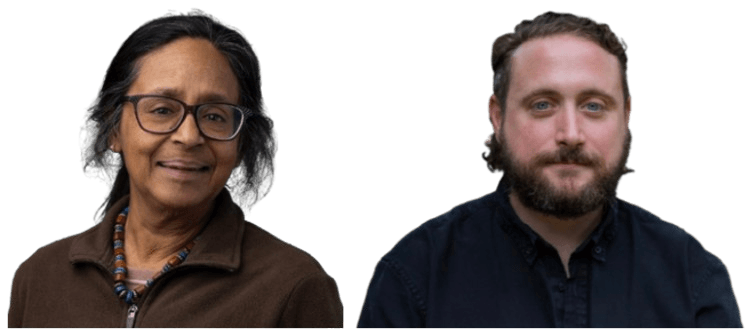
Himanee Gupta & Stephen R. Di Trolio, curators
| Nelson Maldonado-Torres, “The U.S. at 250: Coloniality and Political Zionism in Perspective,” Political Theology Network (April 29, 2025). “The implications cannot be more clear: colonization equals civilization, and civilization justifies annihilation (ethnic cleansing and genocide) as well as dispossession. Here we find a foundational logic in the formation of modern nation-states that is particularly prominent in state building projects that consider themselves to be at the “frontier” of Western civilization.” |
| Samuel Hayim Brody, “Settler Colonialism Reshaped All of American Religion: conversation with Tisa Wenger on Spirits of Empire,” Political Theology Network (March 18, 2026). “My approach here to the Native people who became Christians, like the many Odawa who became Catholic for example, is informed by recent scholarship on Indigenous Christianity that emphasizes the agency and creativity of Native Christians themselves. They cannot simply be seen as sort of dupes of the colonial system, or merely as sellouts, or whatever critical frame a certain generation of scholars might have put upon them, or even what their critics at the time within their own communities might have said.” |
| Zara Surratt, “Between Saddles and Saints: Finding Political Theology at an Indigenous Boarding School,” Political Theology (July 2026). “This article assesses political theology at residential schools from several angles. Scholarship on residential schools for Indigenous youth has powerfully critiqued their inherent racism and profiteering, but has yet to recognize the massive influence of religion. By using the lens of political theology, this impact becomes apparent. At St. Francis Mission School, Catholic immigrant staff members used children as evidence of their own theological and political capacities. Students were seen as characters in stories that superficially concerned their future citizenship, but were ultimately about the teacher’s assimilationist.” |
| Zahi Zalloua, To Exist as a Problem: Being Black, Being Palestinian (Bloomsbury, 2026). “To Exist as a Problem provides a searing critique of such assumptions, arguing that Blacks and Palestinians do exist as a problem, but a different problem than the one dictated by the petrifying white and settler gaze. They exist as a threat because the mechanisms of structural racism make them so. In order for racism to thrive, they must be othered in the profoundest sense.” (Bloomsbury). |
| Rebecca M. David Hensley, “Celebrating America 250 with White Christian Nationalism? Or Democratic Values?,” Good Faith Media (May 27, 2026). “Jesus weeps. Or perhaps he laughs, or drinks copious amounts of water-turned-wine, over the ridiculousness of these deeply connected spectacles of White supremacist, anti-democratic, anti-Christian abuses of power (and abuses of taxpayer dollars). Is there any way out of this mess?” |
| ________. Under Gods: 250 Years, 25 Essays, American Religion (Indiana University Press, 2026). “Under Gods is a narrative examination of the place of the plural in the history of the United States. Leading up to the 250th anniversary of the Declaration of Independence, we asked writers, scholars, and artists to tell stories of religious people, communities, and events throughout those two and half centuries. Each of the resulting twenty-five essays gathered here corresponds to a single decade; together they explore spiritual diversity as foundational and essential to American religious life from 1776 to today. Highlighting moments well-known or obscure, beliefs and practices held by multitudes or relatively few, this portrait is necessarily partial, but it provides a better understanding of the whole.” |
| ________. “Assemblages of Asian Settler Colonial Critique: A Special Issue,” Amerasia Journal (2025). “This special issue consider the multiple place-based genealogies of Asian settler colonial critique, amplifying its transnational, place-based dimensions while also identifying new directions for study. Rather than laying claim to Asian settler colonialism as a field ripe for institutional reproduction, they name Asian settler colonial analytics as an assemblage of multiple approaches, methods and points of departure, signaling their investments in forging ethical relationships and connections with Indigenous peoples, communities, and struggles inside and outside the university.” |
| Sam Hamad, “America at 250: From Anti-Colonial Power to British Empire 2.0,” The New Arab (July 14, 2026). “Yet as America’s image abroad has become increasingly defined by the second republic, Americans themselves have begun asking questions that would have been instantly familiar to Adams, Madison and Jefferson: how much power should a president wield? Can constitutional restraints survive political tribalism? And, ultimately, can their republic survive the accumulation of power by Trump, a wannabe despot?” |
Ecology & Environment (2nd Mondays)
Another climate change-intensified wildfire season is roaring across the globe, killing wildlife and humans, displacing hundreds of thousands, poisoning the air, and consuming millions of acres of land. US-based climate reporter Emily Atkin characterizes the effects of wildfires on air quality as theft: fossil fuel industries are stealing the “perfect summer days” we all deserve to enjoy. The rise of prediction markets has added a new layer of horror to mix, as people can now place bets on the outcomes of wildfires. How might political theology help us think not just about what we lose to climate change, but also the political and economic forces that compound these losses and make it seem like we have to accept them as inevitable?

Warm regards,
Emily Theus & Anupama Ranawana, curators
| Samual Huard, Dean Dettloff, and Matt Bernico, “Degrowth, Christianity, and Liberation: A Conversation with Dean Dettloff and Matt Bernico: Part 1” and “Part 2,” Political Theology Network (July 3 and July 10, 2026). “Degrowth is a message of liberation for us too. Most of us don’t want to live lives that are premised on the destruction of people and the planet. We would prefer not to do that if we had the choice. And yet we don’t have that choice. So, we need to be free of a different kind of violence.” |
| Abel K. Aruan and Claire Blencowe, “The Spirits of Extraction: An Interview with Claire Blencowe,” Political Theology Network (June 17, 2026). “[H]ow do you write about this history [of settler colonial extraction] in a way that acknowledges the violence without adding to narratives that end up saying white people survive and Indigenous people are incapable?” |
| Robert Anthony Orsi, “Sacred Places in a Burning World,” Political Theology (May 2024). “The challenge is whether we will find a way as effectively to stand on sacred ground, for now we know that all of this ruined, burning, flooded ground is holy, every plant, person, insect, reptile, forest, every ocean, river, and seacoast, and every bird. The determination of humans to restore sacred places that they might continue to meet their gods in them might hold clues to the kind of work necessary for the future. It may also hold a seed of hope.” |
| Alice Rudge, “Loss,” Environmental Humanities (July 2026). “Seeing loss as about both love and grief demonstrates its situatedness. Here it is relational, embedded in the rhythms and poetics of multiple interdependent lifeways and temporalities.” |
| Christine Hansen, “Deep Time and Disaster: Black Saturday and the Forgotten Past,” Environmental Humanities (May 2018). “There is no straight line between the loss of Aboriginal lives on the colonial frontier and the Black Saturday disaster more than 170 years later; the one did not necessarily lead directly to the other. But the less savory aspects of how one of the most dangerous fire zones on the planet became home to a sprawling city, a conjunction that has left a massive (and worsening) ecological dilemma for contemporary people to solve, cannot be merely stepped over. Such an oversight further entrenches the lack of intimacy with country that settler society already struggles to overcome.” |
| Amitav Ghosh, Wild Fictions (University of Chicago Press, 2025). “[K]nowing what we now know about anthropogenic greenhouse gas emissions and their role in intensifying climate disasters, it is no longer possible to cling to the fiction of there being a strict division between the natural and the political: wildfires, rain bombs and the life are also deeply political creatures in that they are the by-products of historical processes that have hugely benefited a small majority of the world’s population.” |
| Levi McLaughlin, “Catastrophe” in Critical Terms for Religious Studies, Second Edition, ed. Sarah Hammerschlag (University of Chicago Press, 2025). “[D]efining catastrophe and defining religion are analogous endeavors that connect to and depend upon one another and are formed in tandem by interconnected social and cultural forces.” |
| Jamie L. Pietruska, “Catastrophe Markets,” Aeon (March 27, 2026). “Backlash against Polymarket’s gamification of disaster was swift. Condemnation of ghoulish wildfire markets appeared on social media and in major news outlets. Moral outrage over gambling on death and destruction quickly faded as the news cycle moved on to the next disaster. But the wildfire markets tell a more complicated and maybe even more unsettling story about disaster capitalism, the financialisation of catastrophe, and how humans, including the wildfire gamblers themselves, try to make sense of what it means to bet on disaster in cryptocurrency while the planet is burning.” |
Race & Ethnicity (3rd Mondays)
When reflecting on race and ethnicity, we consider how people experience their heritage and culture, and how they develop a sense of belonging. The Christian Bible teaches that all ethnic communities were created by God, and that diversity is part of creation. At the same time, we are taught that Christ breaks down the walls that divide us, uniting us as one family of God. The question then is how to show respect, seek justice, and create a community in which every culture has its place, and every person is honored. To start this segment, I invite you to look at key terms and discussions below.

Warm regards,
Victor E. Savarimuthu, curator
| Raj Bharat Patta, “De-whitening the White Robes,” Political Theology Network (May 5, 2025). “De-whitening is yet another way of resisting the empire today, calling us to resist all forms of racism, liberating people of colour to overcome ‘I can’t breathe’ situations and scenarios. De-whitening is about celebrating ‘we can all breathe freely and in freedom’ irrespective of our color, caste, gender, sexuality, class, etc. De-whitening is a call to affirm ‘Black lives still and always matter.’ De-whitening is a hermeneutical tool and a decolonial methodological offering, allowing us to be aware of the existing imperial forces in our localities, which might include casteism, patriarchy, classism, xenophobia, colorism, etc.” |
| Shamara Wyllie Alhassan, “Critical Race Theory,” Political Theology Network (February 7, 2023). “[Critical Race Theory] teaches that the very category of race is socially, politically, legally, and economically constructed – not biological. If race is not biological, it means that a world where racism does not exist is possible. If critical race theory becomes a central lens for thinking about political theology, it can inaugurate healing from epistemic harm and invoke the will needed to chart new epistemological coordinates that center the marginalized global majority and advance equitable futures.” |
| Matthew Vega, “Racial Capitalism,” Political Theology Network (May 3, 2022). “It is common for scholars of religion and theologians to gerrymander their fields of expertise into ‘race and religion’ or ‘race and capitalism’ studies. Political theology can help blur (or perhaps expose!) the artificial lines that separate these theorizations by taking time to understand what ‘racial capitalism’ means in a variety of contexts and traditions. The historical and theoretical relationships between race and capitalism are internally contested and in need of further exploration from theologians and scholars of religion.” |
| Siphiwe Ignatius Dube, “African Neo/Pentecostal Political Theology, Black Subjectivity, and Anti-Racism Discourse,” Political Theology (April 2024). “[W]hat the centering of race does is not only to de-abstract the African Neo/Pentecostal subjects from their specific socio-political location of Africa, including all the implications of such a location. Centering race also allows us the opportunity to see continuity in the struggle for black emancipation pursued through a specifically Christian political theology.” |
| Michelle Wolff, “Madonna and Child of Soweto: Black Life Beyond Apartheid and Democracy,” Political Theology (March 2018). “Madonna and Child of Soweto promotes life-oriented public religion that is irreducible to any particular political form. In the painting, the infant Jesus, later crucified as an adult, seeks neither to escape the fragility of humanity nor to avoid the horrors of political execution. This child – black, mortal, and divine – is ‘The Way.’ He blesses viewers with one hand and holds a cross with the other – a cross that foreshadows his suffering, but also his resurrection and ascension.” |
| Katie Grimes, “Breaking the Body of Christ: The Sacraments of Initiation in a Habitat of White Supremacy,” Political Theology (February 2017). “We do not live in the aftermath of slavery; we instead inhabit what Saidiya Hartman terms ‘the afterlife of slavery.’ Though formally abolished, slavery lives on inside our time, continuing to sustain and give shape to adaptive patterns of white supremacy. Willie James Jennings’ claim about the church during the era of chattel slavery unsurprisingly remains true today: the racial identities into whichChristians are born continue to ‘stand at a more decisive level’ than the Christian identity conferred upon them at baptism.” |
| Vincent Lloyd, “For What Are Whites to Hope?,” Political Theology (April 2016). “Those tears [often framed as ‘white tears’] are themselves a re-assertion of privilege, a performance of privilege. Social scripts dictate that crying people, especially crying white people, and most especially crying white women must be comforted. To comfort usually means to apologize, or to say that you really did not mean to offend, or that everything will be alright—each of these a reaffirmation of white supremacy.” |
| Jorge A. Aquino, Race & Religion: Essays / Ensayos / Rehearsals from the Américas (Palgrave Macmillan, 2026). “This book project presents a set of perspectives surveying critical theories of racial identity and racism, in light of the history of colonial and neocolonial Christendom in Latin America and the United States. It frames the fundamental ideological power of racism in Western modernity (since 1492), including the role of racial identification in the globalization of capitalism” (SpringerNature). |
| Christopher A. Williams, Religion, Race, Multiculturalism, and Everyday Life: A Philosophical, Conceptual Examination (Ethics International, 2022). “[This book] takes a spirited conceptualist look back into the history of our development. [It] sets out to explore the ways in which a punditry of human equality continues to lock in unassailably assured logical postures, enabled by the historically intertwined roles played by power and the passage of time, towards the invention and sustenance of social truth” (PhilPapers). |
| Steven M. Bryan. Cultural Identity and the Purposes of God: A Biblical Theology of Ethnicity, Nationality, and Race (Crossway, 2022). “[This book] presents a biblical framework for thinking about cultural identity and experiencing cultural diversity as a positive good that God intended. Writing from more than 20 years of experience in cross-cultural mission work in Ethiopia, Bryan examines historical and political aspects of nationality, ethnicity, and race. This practical examination of cultural ideologies—including multiculturalism, nationalism, and intersectionality—helps readers move from asking, Who am I? to Who are we? as God’s people” (Crossway). |
Gender & Sexuality (4th Mondays)
This month marks the 30th anniversary of the Personal Responsibility and Work Opportunity Reconciliation Act, fulfilling Bill Clinton’s promise to “end welfare as we know it” and cementing into U.S. policy a political stigmatization of dependency. One year later, Cathy J. Cohen famously asked, “How would queer activists understand politically the lives of women—in particular women of color—on welfare, who may fit into the category of heterosexual, but whose sexual choices are not perceived as normal, moral, or worthy of state support?” Cohen challenged queer thinkers to reckon with the material conditions through which our multiple oppressions are produced and to build a queer politics grounded in coalition. The pieces gathered in this month’s stack take up related questions across political theology, queer theory, Black studies, disability theology, evangelical history, and beyond.

Warm regards,
Emilie Casey & Zoe Boyle, curators
| Jules Leslie Webb, “Flannery O’Connor’s Carnival Purity: A Question for Political Theology,” Political Theology Network (May 1, 2026). Jules Leslie Webb offers a transfeminist reading of Flannery O’Connor’s “A Temple of the Holy Ghost.” Drawing on the carnivalesque and Freud’s uncanny, Webb considers how O’Connor’s “Freak” reimagines Catholic theologies of purity and opens new possibilities for trans catholicity. |
| Zahi Zalloua and Benjamin Davis, “Global Critical Theory: A Symposium,” Political Theology Network (July 24, 2026). Zahi Zalloua and Benjamin Davis revisit Frantz Fanon, the death drive, and theories of the human in their symposium on Global Critical Theory. To what extent can psychoanalysis’s radical negativity—its attention to libidinal economies and constitutive antagonisms—unsettle the colonizing impulses of humanism? |
| Judith Gruber et al., “New Methods, New Authorities, New Questions,” Political Theology Network (July 15, 2026). In this online roundtable talk, Jane Barter discusses “theopolitics,” drawing on Jewish thought, feminist liberation theology, and apophatic traditions. Barter considers Annette Wieviorka’s “era of the witness” and explores the possibilities and risks of testimony, which is so often taken up for ends beyond what survivors intended. |
| Emilie Casey and William Stell, “Born Again Queer: An Interview with William Stell,” Political Theology Network (June 3, 2026). In this interview, Stell discusses historical contingency, queer religiosity, and the debates over biblical hermeneutics through which LGBTQ+ issues became a fault line within late twentieth-century evangelicalism. A recorded conversation with Stell about the book is also available through the LGBTQ Religious Archives Network. |
| Mikkel Flohr and Sara-Maria Sorentino, eds., Special Issue on Marx and Revolution, Political Theology (June 2026). Neal Spadafora brings Marx into conversation with Lee Edelman and Meister Eckhart in “Calling the World Dead: Marx’s Philosophy of History and the Question of Theodicy.” Challenging narratives of progress and redemption, Spadafora explores what a non-theodical politics might look like when we refuse the demand that suffering be justified by future reconciliation. Adam Banks and Ahura Sultan revisit Saidiya Hartman’s “revolution in a minor key” in their article “Minor Revolution: From Marxist Hermeneutics to Wayward Theology.” Bringing Hartman into conversation with Amaryah Armstrong’s wayward reading of Hagar, they trace how racialized and sexual subalternity complicate revolutionary visions organized around emancipation as a promised future. In “Bread & Roses: The Soul After Capitalism,” Anthony Paul Farley brings Karl Marx’s engagements with Matthew 25 into conversation with Sweet Honey in the Rock’s “I Remember, I Believe,” Audre Lorde’s “Poetry Is Not a Luxury,” and more, considering how the law extends the violence of primitive accumulation. |
| William Stell, Born Again Queer: A History of Evangelical Gay Activism and the Making of Antigay Christianity (Princeton University Press, 2026). This book traces the contested history of evangelical gay activism and the backlash that helped shape contemporary evangelicalism. Arguing that the antigay majority in evangelicalism has been less dominant and more vulnerable than previously thought, Stell describes a network of authors, ministers, and professors—all veterans of major evangelical institutions—who worked in the 1970s and 1980s to persuade Christians that their churches should affirm the relationships and ministries of gay and lesbian members. By the late 1970s, some even thought that these activists might shape the future of evangelicalism (Princeton). |
| Lisa D. Powell, The Disabled God Revisited: Trinity, Christology, and Liberation (T&T Clark, 2023). “[This book] strengthens and amplifies the claim that God is disabled, made by Nancy Eiesland in her groundbreaking book The Disabled God (1994). … Powell argues that God is not only interdependent within the immanent Trinity, but God experiences real dependency, risk, and vulnerability from God’s ‘original’ self-determination” (Bloomsbury). |
| Kevin Hector, conv. and ed., “The Disabled God: A Syndicate Symposium,” Syndicate Network (May 1, 2026). This symposium returns to Nancy Eiesland’s groundbreaking work in disability theology and asks how queer critiques of corrective projectionism—the tendency to imagine God according to our own earthly values—illuminate tensions within disability theology’s appeals to divine vulnerability. Featured in this symposium are Daniel Rempel, Miriam Spies, Heike Peckruhn, Bruce McCormack, Linn Tonstad, and Willie Jennings, with Powell to respond. |
| Brandon Ambrosino, conv. and ed., “Speaking of Rape: A Syndicate Symposium,” Syndicate Network (May 20, 2026). This conversation considers the limits of language in narrating sexual violation. What happens when the words available to survivors fail to capture the reality of harm? And how might practices of speaking, listening, and restorative justice open new possibilities for repair? Featured are Alisa R. Ackerman, Deanna Thompson, Karen O’Donnell, and Jonathan Tran, with Hanson to respond. |
| Matthew Vines, “I’m Gay, Not Queer. It Matters,” The New York Times (June 30, 2026). “Subsuming the fixed reality of gayness under the much more malleable banner of queerness undermines a core premise behind gay rights: that sexual orientation isn’t chosen. And polling suggests that premise is, indeed, being weakened; the share of Americans who believe people are born gay has declined over the past decade.” |
| Homodoxy: Books Worth Burning This is a new press for gay, queer, and trans theology and literature, officially launched this Spring. Explore the press and submit your book proposals here. |
If you are interested in sharing your own list, being a curator of one of these segments, or creating a new one, email Abel K. Aruan ([email protected]).