
I would like a vote in the decision to choose the next Archbishop of Canterbury. Ideally, if I am honest, secretly, I would quite like to have the only vote. But that would be monarchy, and I don’t believe in that for all sorts of reasons, and nor do I believe in oligarchy, so what I would like to see is a democratic election. Perhaps something like they have in the Episcopal Church in the US, an open contest in which candidates put forward their ecclesial and spiritual credentials…
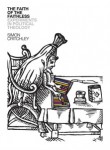
Simon’s book, The Faith of the Faithless: Experiments in Political Theology must be read as throwing down a great risk. Simon enters into the theological and the political domain in ways that are offensive to how these very terms have been shaped in order to stifle action, subjectivity, and even faith itself in the very name of the political and the theological.
A few radical thinkers have recently risked thinking otherwise about theology and the political. But for the most part professors (especially in the context of America) have not been willing to risk thinking otherwise about religion and the political for reasons that can only be explained by how much academic speak has been policed by the assumption that the student is little more than a passive consumer in need of placation through reinforcing their unconscious assumptions (conservative or liberal) in the pretension of being “critical” and “objective.”
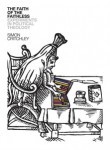
Critchley’s new cookbook for experimentation with quasi-, proto-, or post- political forms of association is compelling, often beautiful. Indeed, one cannot help but be struck by the way such good writing, such clear formulations, of our contemporary political scene have emerged under the rubric of the theologico-political (assuming here that alongside Critchley’s book we could also name Paul Kahn’s Political Theology, Giorgio Agamben’s Power and the Glory, and Eric Santner’s Royal Remains, all important figures in my little pantheon of ‘where we are today’). And while this clustering of such forceful cultural diagnoses under the aegis of political theology for me still feels surprising, maybe this surprise is just the point, an indication of a form of sensibility that has not yet become common, tired, worn out. In any case, this is a surprise worth reflecting on in the sense that we could wonder aloud about why it is that– at this particular moment in time– an attention to the theologico-political seems to focus very directly and illuminatingly on those contemporary paradoxes, deadlocks, or experiences of what Boris Groys explores so provocatively in his Communist Postscript as being oddly “stuck” in and with the problem of the common and the shareable.
Commenting on the role of the state in a recent article in the Church Times (UK), John Milbank as one the leaders of Radical Orthodoxy says that the state has no goals “save its economic power and no interest in the person save as an atomised cog in a well-oiled machine”. In other words, it is hard to see how the state contributes anything other than an instrumental approach to the affairs and concerns of its citizens. Such a negative and dismissive interpretation of the state seems the predominant view not only within influential sources in theology but also from the realms of more radical political philosophy. Why is this so and is it a satisfactory and adequate understanding? If it is not, what alternative approach might be adopted by a Political Theology?
It’s easy to see why Santorum might appeal to some culturally conservative Catholics and moderate evangelicals who are wary of Democrats but also turned off by the Republican Party’s cozy embrace of economic libertarianism and tireless defense of struggling millionaires. Santorum is more comfortable with communitarian language, has been a strong supporter of foreign aid to impoverished countries and connects with personal stories of his blue-collar upbringing. But it’s a political delusion to think Rick Santorum is a standard-bearer of authentic Catholic values in politics. In fact…
With the elections in Spain two weeks ago, the first modern government to explicitly model itself on the work of an academic political philosopher was voted out of office. The Spanish Prime Minister, Jose Luis Rodriguez Zapatero, had become a devotee of the Princeton political philosopher Philip Pettit in 2000, when Zapatero was leader of the opposition searching for how to envision left-liberal politics distinct from the Clinton-Blair “third way.” As a Zapatero associate put it, “Philip Pettit provided us with the appropriate grammar to furnish our political intuitions, to express the kind of proposals and dreams we had in mind for Spain. Pettit’s republicanism has been our north star.” Does the political philosophy that Zapatero found so compelling, civic republicanism, leave a role for faith?
The editors of Political Theology are pleased to announce that the latest issue is now available on the web. Issue 12.6 (December 2011) carries a special section devoted to issues of migration and asylum, and features a guest editorial on ‘Migration as a Challenge for Theological Ethics’ by David Hollenbach, SJ, who holds the University Chair in Human Rights and International Justice at Boston College. This is followed by three related articles by Elena Namli, from Uppsala University, Sweden; Mark W. Potter, who is the Provincial Assistant for Social Ministries of the California Province of the Society of Jesus; and Anna F. Rowlands from the Margaret Beaufort Institute, University of Cambridge. The editorial and review open access. The full table of contents appears below: