
Prophets certainly tend to be charismatic, which suggests that charisma can potentially serve as an index of ethical leadership, but prophets aren’t always charismatic, at least not in an obvious way.
How can history be understood in terms of its possible end? Anna Pollman reads Obsolescence of the Human as a “historically supraliminal” book.
Like Narcissus who died through being consumed by self-obsession, postcolonial critique is dazzled by the perverse logic of colonial value despite wanting to separate from it.
European thinkers in early modernity, John Locke chief among them, looked to Europe’s encounter with Indigenous peoples and pored over the developing body of “native information” to lay the foundation of a political order not derived from Scripture or Church Authority but from presumptively secular natural rights and reason of “the people.”
PTN members now receive a monthly thematic reading list with the most recent conversations on their topics of choice.

There is a priority of love such that the essence of being Christian is to love straight (in the sense of undiluted love) rather than get caught up in straight love hegemony.
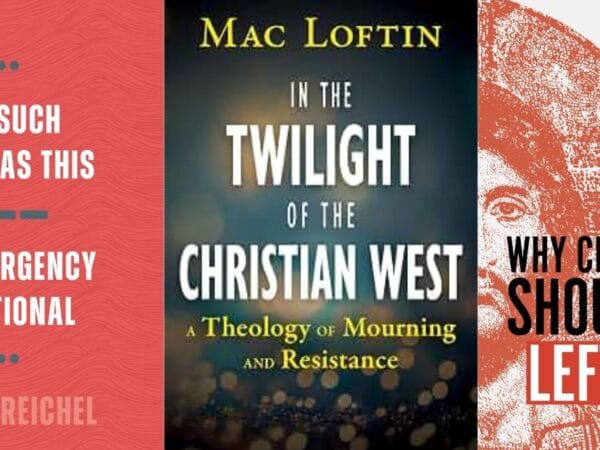
We invited Mac Loftin, Hanna Reichel, and Phil Christman, authors of recent books speaking to our present moment of crisis, to reflect on the other two books — and the state of the world.
To gain power, some leaders buttress their narratives with their institutional credentials, while others rely on intangible but often more powerful authority: the authority of charisma.

The catholicity of dreams makes them powerful but politically ambivalent. In my mind, the dreams of utopian Christianity are no different.
For Anders, the problem is not that humans have created a world of artifice. Rather, the problem is that in the modern technological environment we make products that are not measured on the basis of human needs but dramatically exceed them.
Joseph Tonda centres his study on African societies and their diasporic communities to describe a global tortured, torturing human state from which there appears to be no escape. His metanarrative establishes that we are all entangled as victims.
Timothy Vasko’s Making All the World America documents how theological hermeneutics and post-theological thought that emerged in late Renaissance and early Enlightenment discovery discourses were renegotiated through native information