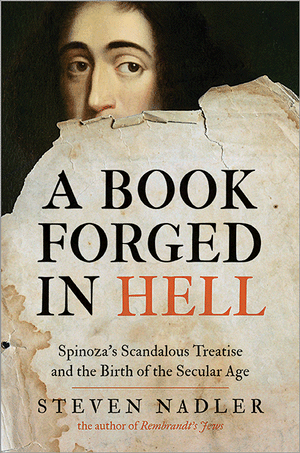
Writing in May, 1670, the German theologian Jacob Thomasius fulminated against a recent, anonymously published book. It is, he claimed, “a godless document” that should be immediately banned in all countries. His Dutch colleague, Regnier Mansveld, a professor at the University of Utrecht, insisted that the new publication was harmful to all religions and “ought to be buried forever in an eternal oblivion.” Willem van Blijenburgh, a philosophically inclined Dutch merchant, wrote that “this atheistic book is full of abominations … which every reasonable person should find abhorrent.” One disturbed critic went so far as to call it “a book forged in hell”, written by the devil himself.

That the resurrection is a beleaguered doctrine in North America and in Europe is hardly a new revelation. For all its technological wonders, modernity is uncomfortable with old-fashioned miracles. Pre-modern ways of talking about Jesus’ resurrection don’t translate easily for an audience that demands scientific corroboration and empirical evidence. As a result, Christianity has chastened and tamed this story in a number of ways.

Is God a Socialist? And if so, what kind of socialism does God espouse?
We have spent now four posts tracing the historical development of Protestant two-kingdoms theology, and its influence on early modern political thought. This has all been an attempt to vindicate the claim, advanced in the first installment of this series, that the wider world of political theology has good reason to attend to the disputes over this doctrine that have heretofore been the province only of a characteristically combative subgroup of the American Reformed. Has it been vindicated?
What should be read as a text which presents God as the champion of and in solidarity with the oppressed, can all too quickly be read as presenting God as the Santa Claus at the mall promising you everything you want. But that’s not what this text is about.
This makes the book of Ruth a deeply political subject, which is very different from much of the popular appropriation of the book, which emphasizes the relationships first between Ruth and Naomi, and then Ruth and Boaz. These are important pastorally, but there is still much left to learn from the book that goes beyond these narrow concerns…
One of the reasons why Amos made people squirm in his day and why Belhar irritates us in our own is because those of us used to being in charge have little practice in and less patience for listening to people whom we deem to be our inferiors.
Emma Goldman once said “If voting changed anything, they’d make it illegal.” Goldman was speaking of the bourgeoisie democracy that upholds the status quo of US society. Her words have rung true for many of us progressives who voted for President Obama. We have and grown increasingly frustrated as his administration has leaned toward the status quo rather than the oppressed and poor. This week’s lectionary reading tells of a man who was part of the status quo in his society, high in power and authority in Ethiopia, yet God’s Spirit had something else in mind for him, an apostle named Philip….
In many ways, the text represents what is happening in global Christianity, which Westerners still believe is centered in Europe and North America, but which is actually diminishing there by the day even as the faith explodes in the Two-Thirds World.
Today, speaking in tongues and prophecy are more apt to be equated with personal piety than political resistance. This too represents an incomplete understanding of Christ’s ministry and mission.
In this present age, we are beset by people, inside and outside of the church, who are on an anti-tax jihad.