
When I was asked to contribute syllabi on political theology I thought it would be a great chance to look back and reflect on how my thinking and teaching on the topic have evolved. I think of a course I am currently teaching under this rubric, even though its title and official description eschew all reference to theology, and some of the very first courses I taught were expressly geared toward the topic of political theology.

The revival of interest in political theology at the turn of the millennium began with Islam, then moved to Christianity. In the wake of September 11, 2001, it became clear that not all religion was fading away, nor was all religion confined to the private sphere. The evidence: radical Islam. But the obvious risk of Islamophobia that accompanied a focus on Islam as anomalously growing and anomalously public prompted some scholars to explore how Christianity itself was neither fading away nor thoroughly privatized. Instead of focusing on Islam as anomaly, political theology provided a framework for complicating the West’s story of itself, for probing the complex and continuing relations between religious and political ideas.
The Notre Dame Institute for Advanced Study hosted a conference at the beginning of this month on Theology and Black Politics. Opening with the question: “What is the Black Church?”, the conference addressed fundamental concerns regarding the nature of black politics and theology.
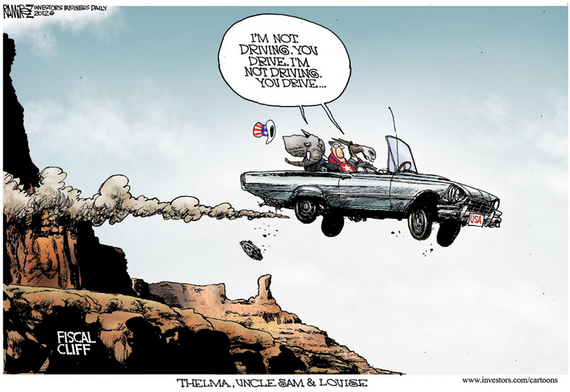
Four years ago, I was an idealistic college student who believed in change. Frustrated with the years of Bush-style imperialism and capitalism, I was ready for some big government and the return of civil liberties, singing the doxology Praise God From Whom all Blessings Flow as balloons reigned down and Obama waxed eloquent on a stage overlooking thousands of people. Needless to say, I have learned my lesson over the last four years. Although a less harmful sovereign, Obama turned out to be—surprise, surprise—a neo-liberal. The problem, however, was not with Obama, it was with me….

Joshua Brockway, Director of Spiritual Life and Discipleship for the Church of the Brethren, seeks a path beyond the recent conversations on the survival of Liberal Christianity.
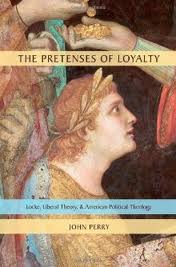
Chapters 4 and 5 of Pretenses of Loyalty constitute the heart of Perry’s argument, offering as they do an intriguing re-interpretation of Locke’s Letter Concerning Toleration and revealing the tensions that will bedevil it in following centuries. Perry’s overall thesis, we will recall, is that modern liberalism suffers from an amnesia, forgetting that there are in fact two prerequisites for a successful policy of religious toleration: harmonization of loyalties and abstract respect. Relying upon the latter alone, modern liberals find themselves flummoxed at the frequency with which border conflicts erupt between religion and politics—having agreed to tolerate all purely religious practices, governments find that many believers insist on expanding the scope of their religion to include civil matters. They ask that believers consent to be led behind a veil of ignorance, willing to treat others and themselves be treated as abstract rights-bearers, but many believers refuse.