Kahn’s book is intriguing and in many places insightful, conversant in theoretical literature ranging from that of Giorgio Agamben to that of Brian Leiter. I have two worries, one about Kahn’s similarity to Schmitt and another about Kahn’s difference from Schmitt. I worry that the richness of Schmitt’s treatment of theology is diminished in Kahn’s treatment, with theology being reduced to religion – religion that sounds quite liberal and quite Protestant. And I worry that Kahn, like Schmitt, may not provide sufficient space for difference (racial, gender, class, and even religious) in his constructive account. I will approach these worries indirectly, after first rehearsing some of Kahn’s discussion of sovereignty.
Kahn assumes the United States, as a state, to be a ‘norm’ and does not seem to grapple with anything or anyone external to it: his focus is internal. I would like to suggest that immigrants have been constructed as the quintessential exception – an exception made on the basis of nationalism rather than liberal political theory, though – and that this is generating the kinds of restrictive immigration legislation… Would-be-immigrants are dealt with outside the nation (offshore processing) or hidden within it (detention), preventing their access to legal ‘norms’ available to citizens.
I broke one of my cardinal rules today, again, and was reminded, again, of how incredibly difficult the law of love really is.
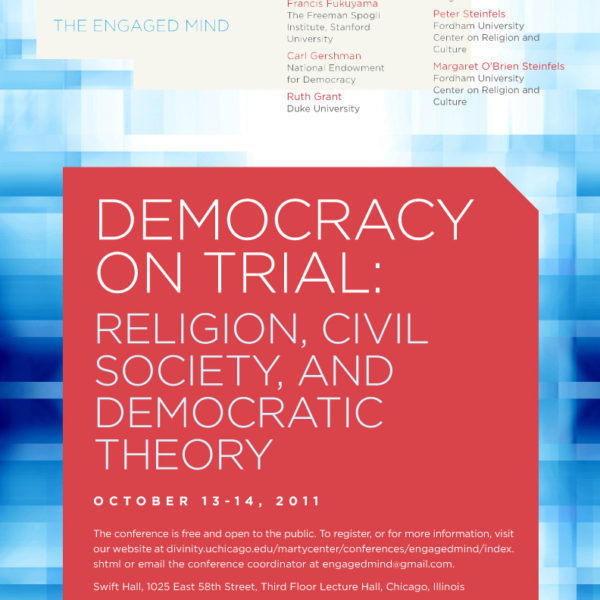
What is the state of our democracy? Is democracy good for the world? How does religion support or hinder democratic practice? Throughout her career, Jean Bethke Elshtain has challenged both liberal and conservative approaches to politics, emphasizing the crucial role that the mediating institutions of civil society play in a successful democracy. She has identified the forces that oppose democracy: identity politics, utopianism, and an elitism that denies ordinary people the prerogatives of citizenship. Yet she has consistently maintained a realism tinged with hope, pointing to Jane Addams as an exemplar of lived democratic practice.
In the days and weeks – indeed, years – before the execution of Troy Davis, a variety of voices, many purported theological, others secularized, addressed his case. Some argued that Troy Davis was innocent. They pointed to the details of his trial, including witnesses who had changed their testimony. Innocence is a tricky, and a dangerous, rhetorical implement. At the end of the day, we are all guilty. But the point that the Davis case illustrated is that our guilt is always opaque. To pretend that guilt is transparent may be necessary in some circumstances, but in such cases there should always be a spirit of humility.

We are in an economic crisis, but we are also in an identity crisis. Who are we? What do we, as a nation, stand for?
While I would not want to deny the political importance of forms, I would add to this analysis the importance of the kinds of spirit or inner drive (desire) which may be astir in them. An essential part of the explanation for the enormity of 9/11 is that the terrorist network responsible for them was not animated by a drive to produce new configurations of value and meaning so much as by a reactionary desire to bring judgment upon forces of modernity which were perceived to be a threat to established (traditional religious) values. The animating spirit of terrorist networks is a spirit of ressentiment.
Political Theology 12.5 (2011) is a special issue entitled ‘Ten Years After 9/11’, in which twenty-two contributors from across the religious spectrum take stock of the events of September 11, 2001 and their aftermath. Perspectives are offered from theologians, specialists in the study of religion, historians, philosophers, ethicists, anthropologists and political scientists. A number of the contributors are active in the area of interreligious dialogue and interfaith relations. Some are grassroots activists.
As we in the West celebrate their accomplishments and support their efforts, it is important to temper our expectations and widen our conception of responsible government. The heritage of most Christian reflection on politics has been relatively pragmatic concerning acceptable and appropriate social arrangements.
Nevertheless, murder is never moral–regardless of whether it is done in the name of religion, politics, the nation, ideology, etc. Any such killing of civilians–by the left or the right, religious persons or atheists–is to be denounced loudly and clearly as morally wrong.