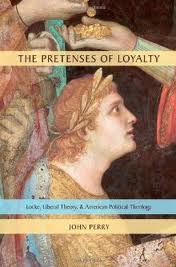
John Perry’s recent book “The Pretenses of Loyalty” offers a clear, penetrating, and persuasive diagnosis of the predicament of contemporary liberal political theory through consideration not only of its present tensions, but more importantly, of its amnesia regarding its historical foundations. I say clear because Perry’s exposition is tightly focused, lucidly written, and structured so as to ensure ease of understanding. By missing no opportunity to repeat his main thesis and the key issues at stake, he walks a fine line, to be sure, between assisting and insulting his readers, but ultimately avoids the latter in my judgment. The diagnosis is penetrating because it does not rest content with surveying the ongoing contemporary conflicts between politics and religion and the critiques marshaled by communitarian theorists such as Michael Sandel and Stanley Fish—though he does this admirably in the first two chapters—but digs right down to the historical roots of liberal theory, the amnesia of which, he argues, is largely responsible for its present predicament….
The author of Ephesians is addressing the conflict between Jew and Gentile Christians (“the cut/circumcised” and “the uncut/uncircumcised”). The politics of this text could be boiled down to the first century conflict between these two groups. It’s a definition so basic and so simple that it belongs in a Politics 101 course. Where it gets interesting, however, is not how one defines the conflict, but how the author of Ephesians deals with it…..
Méadhbh McIvor, special projects editor, interviews Erin K. Wilson on her book Religion and World Politics: Connecting Theory with Practice. They discuss how her book “tries to move us away from this surface-level essentialist thinking about religion and provide people with a practical guide for how to incorporate religion into analysing world politics without over- or under-emphasising its importance.”

The following post contains information that may be of interest for those attending AAR/SBL in Denver this year.

The idea of opposition then is not about establishing a negative position for its own sake. Instead, to embody opposition here is to draw a line, and this line constitutes a limit-experience. It as if to say, ‘enough is enough.’ So, this opposition is an ending and a beginning.
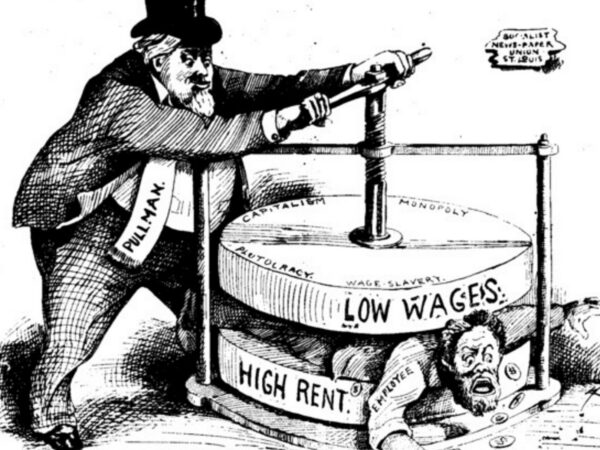
While some white American converts to Pentecostalism in the early 1900s were experiencing a resurgence of Jeffersonian populism of that era, Mexican nationals were living through revolutionary upheaval of their own. And like the older populism of American evangelical lines, the Mexican revolution’s radical populism was also agrarian, influenced by Jacobinism, and hostile to establishment elites.

While not often recognized as political theology proper, environmental justice movements have for decades been sites of normative creativity. Sometimes overlooked as conventional rights-based complaints against locally unwanted land uses, these movements have in fact depicted ecologies of white supremacy while deploying rights, sacralizing land, and reimagining the human in ways that would utterly reconstruct the basis of politics.
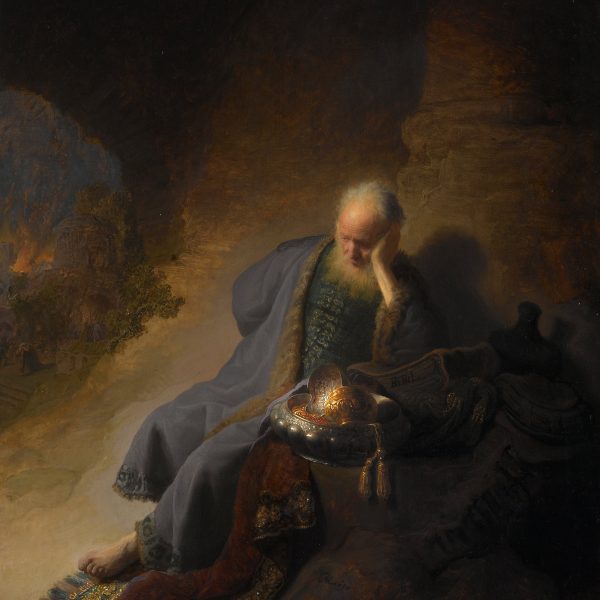
God’s prophets are those who call us to recognize our limitations before the sovereignty of God. Indeed, Jeremiah reminds us of the relativity of human politics and that in God alone does the individual and human society find meaning and security.

…My list focuses on the other conversation, religious voices or theologians, whether practical or professional, immersed in the concrete or engaged in theorizing. My aim is to suggest the kind of reconciling work that Vincent calls for between theology and critical humanities. Such a move makes profound sense to me—emerging as it does out of the tensions within my own biography.
. . . The concept undeniably has a certain appeal, and few slogans are better calculated to capture the imaginations of the young and disaffected than “Towards eucharistic anarchism” (Bill Cavanaugh’s phrase in Radical Orthodoxy) and other such brazen assertions of liturgical politics. But in all the talk of eucharistic politics, a surfeit of aesthetic appeal seems to have usually compensated for a shortfall of logical clarity.

Why is populism persuasive and specifically persuasive to these religious Christians? Said another way, what makes right-wing populism seem, to deeply religious people, like the ‘ethical’ stance?