
It is imperative to respect the claims of conscience behind the pacifist convictions often associated with the rejection of the modern state. But if Catholic social teaching is going to incorporate nonviolence more fully, it also must develop the connection between nonviolence and modern politics.

By disrupting pernicious claims to transcendence, atheist political theologies can help us redress suffering in particular places while keeping hope for radical transformation.

“How might my child and I leverage the love of our family and ourselves to promote decoloniality that resists anti-Indigeneity with the persistent, sometimes subtle, power of Indigenous aunties?”
The Institute for Theology and Politics (ITP) is conceived to be a generator for establishing the first Balkan, i.e., post-Yugoslav contextual theology with a political-theological and theological-liberation orientation.

God’s call is not to engage in politics of personal power or self-service, but engage in a politics of liberation, one that ends the idolatrous hold on power so many have.

In hearing [Fadl’s] story, we follow the travels of wandering saints and pilgrims, the insurrections of Malayali and Arab rebels, and the armed forces of the British and Ottoman Empires.

“Instead of neatly separating the forms of resistance to biosovereignty into life-affirming struggles and necroresistance and mapping them (and life and death) onto the reform/revolt dichotomy, I suggest that we conceive life and death as relational rather than oppositional categories. For every differentiation and intensification of death creates new possibilities of life; and every differentiation and intensification of life entails experiences of “death” that cannot be reduced to the power of one’s death.”

In this short essay, written from my perspective as a Jewish feminist, I draw together a plurality of engagements with natality to engender new conversations in political theology.

Joan Wallach Scott’s On the Judgment of History serves as an invitation to uncover a multiplicity of traditions, perspectives, and forms of agency that embrace discontinuity and tension while resisting closure, and the essays in this symposium function as an active experiment in precisely this type of endeavor.

While kinship has traditionally held a vibrant conceptual life in anthropological inquiry, more recent studies on kinship as a form of spiritual relationality have opened up a new space of interdisciplinary exploration for political theology.

Who produces American history textbooks? Beyond historians’ work, this question demands a reckoning with political partisanship that creeps into the publication process of history textbooks. A comparable phenomenon can be traceable in ancient textualization of sacred memory. Acknowledging political forces in knowledge production helps renegotiate one’s perspectives on sanctioned discourses of historical memory in modern and ancient worlds.
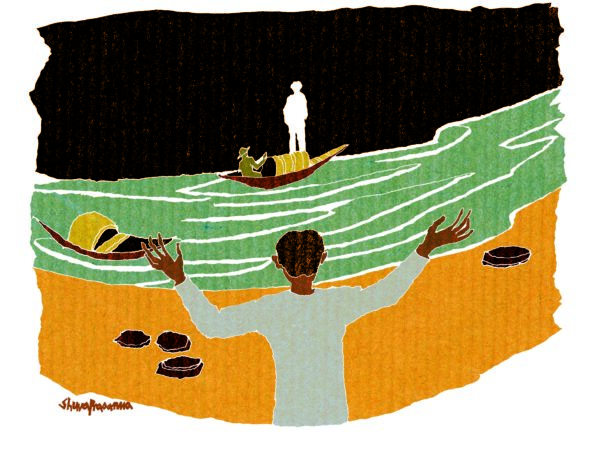
In Conversation: Dipesh Chakrabarty and Alapan Bandyopadhyay, with an introduction by Milinda Banerjee. Translation by Milinda Banerjee and Sreyoshi Bose.