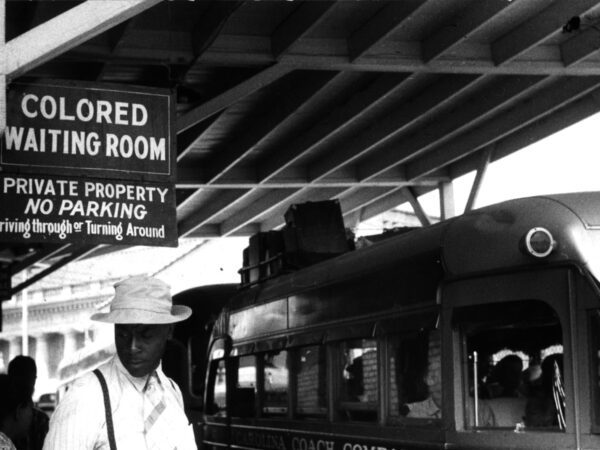
Simply put, Black men are the most loyal group of male voters for the Democratic candidate for president. Their slightly lower numbers for Hillary Clinton in 2016 rebounded for Joe Biden in 2020. Their loyalty to Democrats in this regard is surpassed only by Black women.

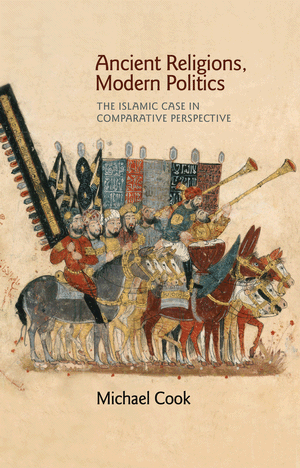
Last November, members of a Sunni militia in Syria went to a hospital, found a patient whom they took to be a Shi‘ite, and beheaded him. Showing a typical jihadi concern for public relations, they then made a video about the incident in order to get their message out, saying of the Shi‘ites: “They will come and rape the men before the women, that’s what these infidels will do. They will rape the men before the women. God make us victorious over them.” As it turned out, their video proved a bit of an embarrassment: it emerged that the man they beheaded was not in fact a Shi‘ite — but as jihadis will tell you, and not only jihadis, these things happen.
We have all been around people who constantly tell stories in which the person telling the story is also the clear hero of the story. And none of us wants to be that person. I think this should be the case not only in the sharing of personal anecdotes, but in the stories we tell one another professionally about our professional lives, so it would be disingenuous to write a series on teaching political theology which leaves readers with the impression that I have it all figured out (or think that I do!). This month I want to share a story about a particularly persistent problem in teaching political theology – one to which I will not suggest I have the answer.
As the humanities have rediscovered religion, new sorts of questions are being asked about religion and politics. Religion is no longer imagined as a check box, as the social sciences would like to see it: something you have or don’t, something that comes in one of several flavors of belief. Now that religion is not only about belief but about practices and ideas, with histories, intertwined with other practices and ideas, the intersection of religion and politics is no longer a point, but a varied terrain with multiple dimensions. […]
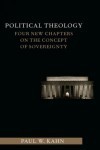
A sensible theologian gets used to the marginalization of theology in the mainstream academy. To find a book about the importance of political theology by a legal scholar at Yale is, however, cause for excitement. Paul Kahn’s exploration of, and extrapolation from, key themes in Carl Schmitt’s classic work goes beyond the usual association of political theology with fundamentalism and shows how even a liberal political order has a theology of its own. There has been no “resurgence” of religion; Kahn sees rightly that Mark Lilla’s “Great Separation” never happened, and that even liberal nation-states like the U.S. have taken on the aura of the sacred. Kahn’s insightful comments about nuclear warfare make this point acutely: “How is it that a political order that understands itself as characterized by the rule of law can hold forth the possibility of such destruction?” (11-12). It can only be because the nation has taken on an infinite value, and the popular sovereign, or nation as god, must retain its exceptional powers to act. In times of war, the President embodies the people like Christ embodies the whole (86). Liberal theories like that of Rawls have never properly come to grips with the violence of the nation-state and the persistence of sacrifice in modern politics.
All of this and more is expanded upon in quite brilliant fashion, and I remain grateful to Kahn for opening up new lines of inquiry that may have been heretofore closed to legal and political theorists. In the end, however, there is less convergence than first appears between political theology as Kahn understands it and what goes under the same name in the present journal.

Jesus’ call to a ‘let-it-be righteousness,’ awash in basileia imperatives, upends despotic designs. Resistant to rule-following, a let-it-be righteousness confounds and dismantles the 3 P’s of oppressive regimes: propriety, purity, and piety.

Those who presume upon God’s support but act in ways that defy God’s standard will find their presumption turned upside-down in divine disavowal.
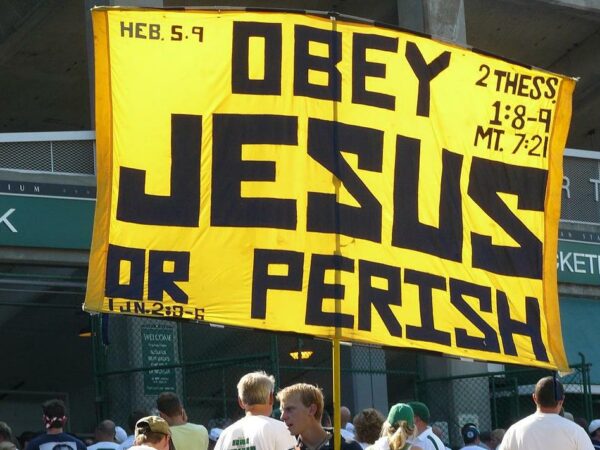
To understand what’s going on today, we need to understand the 400 year story of Christian privilege in America.
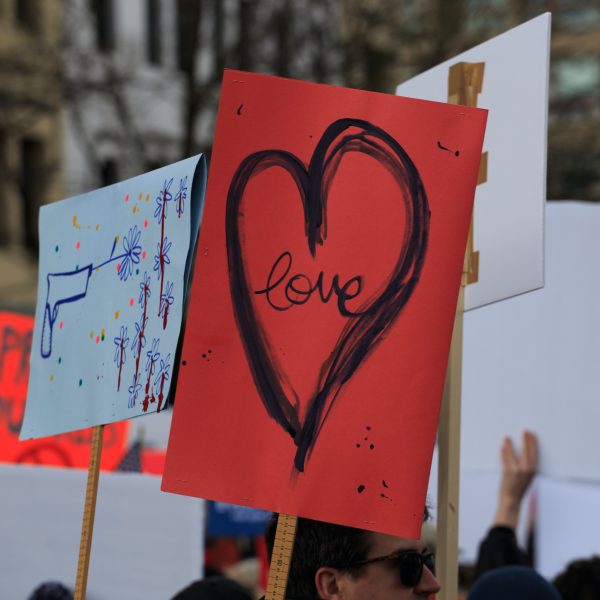
When we read of God enthroned as the great king, perhaps we can imagine a system of governance where our political rivals are not beaten into submission, but are disarmed by love; where those who are different from us are respected, listened to, learned from; where brute force is neutralized by a refusal to retaliate and is resisted through active non-violence. Toward this end, God is indeed the great leader, the one who models “power under” for all of us.
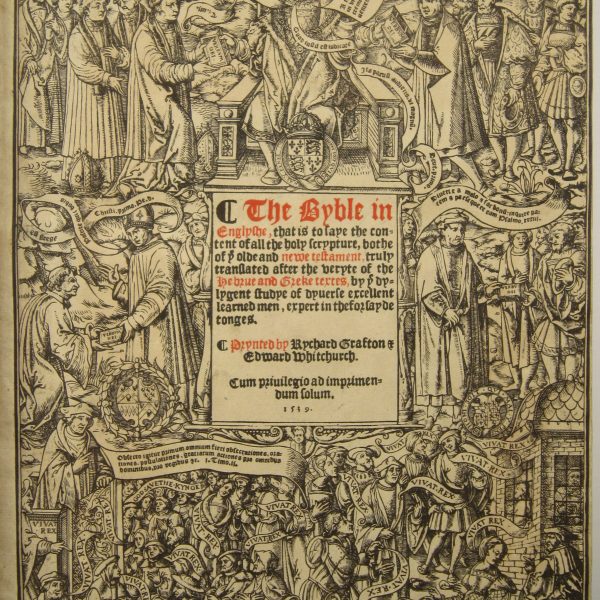
…any consideration of the question of the political implications of naming certain scriptures ‘sacred’ will be severely limited if it is not attentive to sacred scriptures qua material (or digital) books.
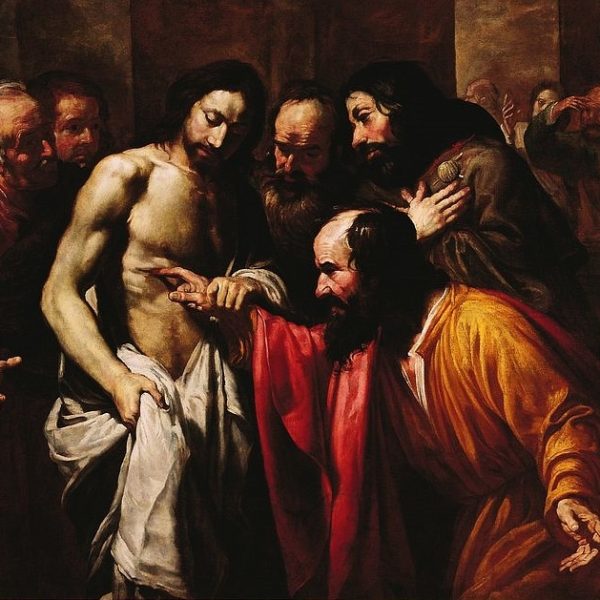
Real faith knows and embraces doubt and questioning. Rather than locking ourselves in, as the disciples first did, we should learn from the curiosity of Thomas. The opposite of faith is not doubt but fear, and it is time to shed our fears.