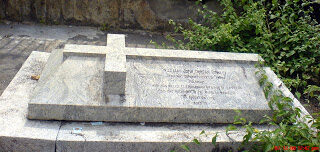
This article demonstrates how the living memories of Malabar rebellion evade the logic of the historical narrative. The native memory of the rebellion appears to have subverted the neatly drawn schemes such as ‘Hindu’ vs ‘Muslim’, ‘cruelty’ vs ‘compassion’, and ‘horror’ vs ‘fascination’ etc. that animate the logic of historical writing.

God’s recurring appearance in Susan Taubes’s novel Divorcing confirms the work’s alarming in-sight about the seductions of patriarchal authority while also dramatizing fiction’s imaginative power.

Jesus’ teaching in the Sermon on the Mount unsettles many biblicist ways of understanding Scripture. It may even be better to move from speaking of ‘the Scriptures’ as a noun, to speaking of ‘Scripturing’ as a verb.

Any power we might feel we gain through the power over dynamic is illusory and fleeting, and will always eventually result in our death/defeat, with our illusions of power lying dead around us.

The God of Israel does not get so caught up in the national agenda that God neglects the prayers of individuals in pain. The best antidote to politics-as-usual is proper worship. Praising YHWH can keep our feet flat on the floor. As we worship the God who sees and the God who acts on behalf of the downtrodden, we seek to become like God. YHWH, rather than the human powers that be, becomes our model. In worship we become attentive to the things that God attends to, such as the grieving woman whose empty cradle signals an uncertain future.
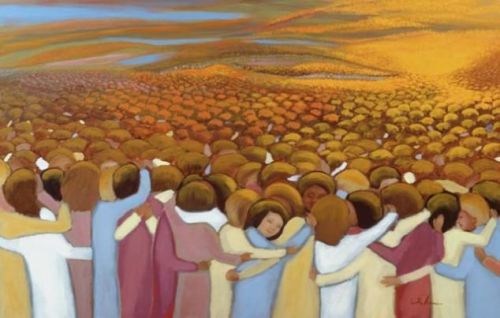
The ecclesiological model that emerges from reading Paul and Mouffe could allow us to position the church itself as a politically and theologically diverse community within the larger society. The role of the church is not to strive towards articulating one uniform voice, both within or in public spaces, but highlight various and even rival voices.

Accompaniment in fear, in suffering, in trauma: that seems to me to be an appropriate call for Christians over the past three Easters. We are still sitting in a messy, middle space – enduring in grief, and hoping for a new day, a new creation.

Signifying a critical homology between the fields of Black studies and political theology, gratuitous violence is an important keyword for interrogating how religio-political concepts can afford unique insights into issues of slavery, race, and the human which continue to inform our world today.

Luke 15:11-32 serves as a warning instead of model to imitate.

The political message of the ambiguous reference to a stump in Isaiah 6 might lie not in the text itself but rather in the history of its redaction.

Berlant is our preeminent contemporary theorist of how intimate practices bleed into and with national formations, and condition specific and powerful fantasies for what a good life or functional society would involve. To read their work is to become attuned to a set of dynamics that can be excavated in any given scene: the attachments being made and unmade, the forms of belonging that flash up and dissolve, the feeling-worlds that mediate everyday life, what remains unfinished.

What if we treated death and suffering as having the last word? How would that change us and the world we live in?